liveBook · Manning

A/B test

As explained in High Performance Unity Game Development

A/B testing is an experiment that compares two or more variants by assigning them to different user groups and measuring the resulting outcomes.

A/B testing compares gameplay outcomes by assigning different balance versions to separate groups of users. Comparing retention between groups helps assess whether a balance change made a difference. section 9.6

Testing a gold reward

Give group A 50 gold for completing a level and group B 100 gold, then compare retention. Keeping other outside factors similar helps attribute a difference to the reward change. Multiple balance versions can also test several changes at once. section 9.6

Figure 9.9 We can split our users into two groups and have one group load balance A, and the other can load balance B. Then we can measure the retention of each group to determine which balance performs better.
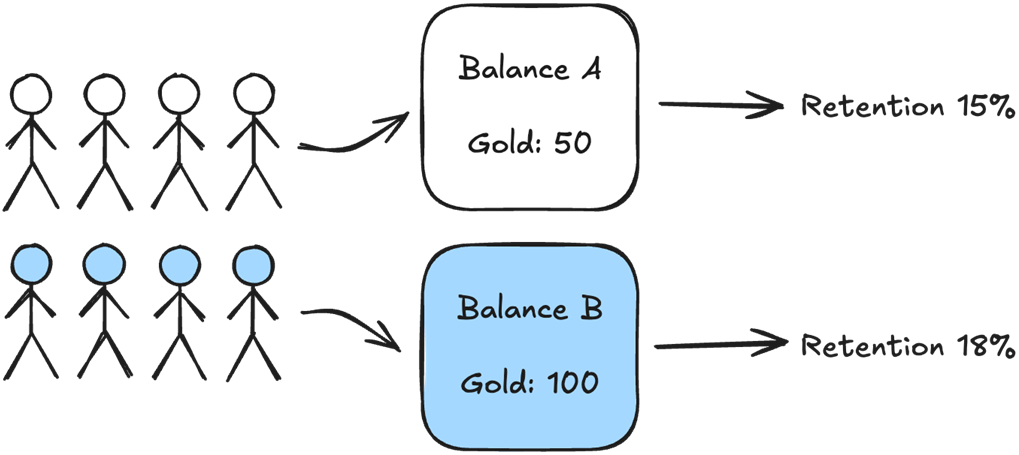
The diagram shows assigning balance A and B to separate user groups and comparing their retention. section 9.6


How High Performance Unity Game Development covers it

How deep it goes
Explains group assignment and outcome comparison through a reward example, without detailing statistical analysis.
Examples
Tests 50 versus 100 gold per level completion and describes running five balance variants.
What it assumes
Assumes balance values can be separated into versions and assigned to different user groups.
What you can do after
Evaluate whether a balance change improves retention by comparing outcomes across user groups.
How it connects
Connects game balance changes with player retention and live balance updates.

Also explained in

Compare how 5 books explain A/B test →

Related concepts

This explainer was generated by Manning's knowledge graph from the text of High Performance Unity Game Development. The section links point to the parts of the book it draws on.