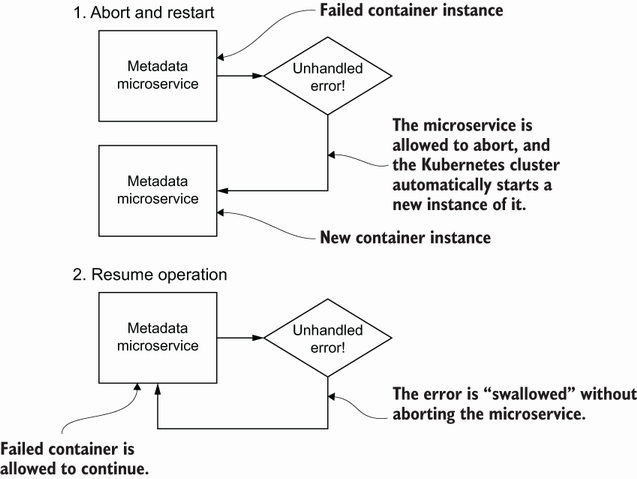
Abort and restart is an error-handling strategy that terminates a failing process and starts it again.
Abort and restart handles unexpected errors by allowing the failing process to terminate, then starting it again. In Node.js, an unhandled exception aborts the program; Kubernetes can automatically restart an aborted production microservice. section 11.2.2
Apply the strategy by:
Leaving unexpected exceptions uncaught when no specific corrective action is available. section 11.2.2
Relying on the deployment environment to restart the aborted service. section 11.2.2
Avoiding uncaughtException handling when continuing could leave the process in a bad state. section 11.2.2
Figure 11.3 Strategies for handling unexpected errors
Compare abort-and-restart with resume operation as the two general responses to unexpected errors. section 11.2.2
How Bootstrapping Microservices, Second Edition: With Docker, Kubernetes, GitHub Actions, and Terraform covers it
How deep it goes
Explains default Node.js behavior and Kubernetes recovery, but stops short of detailed restart configuration or corrective logic.
Examples
Uses unhandled Node.js exceptions and Kubernetes-managed production microservices as concrete examples.
What it assumes
Assumes familiarity with processes, exceptions, Node.js, and Kubernetes while distinguishing aborting from resuming execution.
What you can do after
Operate/configure services to let unexpected failures abort and depend on Kubernetes to restart them.
How it connects
Connects unexpected errors with exception handling, resume operation, Node.js, Kubernetes, and microservices.
Kubernetesused by · Kubernetes is an open-source platform for orchestrating and automating the deployment, scaling, and management of containerized workloads across computing clusters.
error handlingkind of · Error handling is the practice of detecting, representing, propagating, reporting, and responding to errors or failures during software operation.
This explainer was generated by Manning's knowledge graph from the text of Bootstrapping Microservices, Second Edition: With Docker, Kubernetes, GitHub Actions, and Terraform. The section links point to the parts of the book it draws on.