Error handling
Error handling is the practice of detecting, representing, propagating, and responding to failures that arise during software execution or operation.

Coding with AI
Error handling is the detection, management, and reporting of failures that occur during program execution.
- How it is used
- Adds robustness to AI-assisted code by anticipating execution failures and edge cases.
- How deep it goes
- Recommends handling edge cases and exceptions, but gives no general implementation or taxonomy.
- Examples
- Uses duplicate database entries, missing quiz answers, and database-fetch failures as cases to handle.
- What you can do after
- Apply fallback mechanisms for duplicate entries and handle missing quiz answers or database-fetch failures.
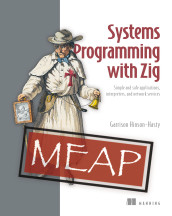
Systems Programming with Zig
Error handling is the representation and handling of failures that can occur during program execution.
- How it is used
- Uses explicit failure paths to make command-line utilities, HTTP servers, and C-compatible interfaces more reliable.
- How deep it goes
- Explains error sets, propagation, response choices, and error-only cleanup through practical code, without a full treatment of error types.
- Examples
- Uses a cat utility, an HTTP echo server, and a nullable-pointer C wrapper to illustrate failure handling.
- What you can do after
- Apply it in Zig by inspecting error sets, propagating failures, and choosing user-facing or server responses.
Read how Systems Programming with Zig explains error handling →

Go in Action, Second Edition
Error handling is the practice of detecting, representing, propagating, and responding to conditions that prevent normal computation.
- How it is used
- Handles failures explicitly near their origin and carries useful information across package and concurrency boundaries.
- How deep it goes
- Explains error returns and immediate checks, then gives guidance on contextual wrapping, error identification, and exceptional panics.
- Examples
- Uses a key/value store interface and a log-and-exit check to demonstrate error returns and responses.
- What you can do after
- Apply Go error checks, logging, wrapping, and errors.Is or errors.As to handle and identify failures.
Read how Go in Action, Second Edition explains error handling →

Bootstrapping Microservices, Second Edition: With Docker, Kubernetes, GitHub Actions, and Terraform
An error-handling strategy is a systematic approach for detecting, responding to, and recovering from software errors.
- How it is used
- Plans responses and recovery to minimize harm when application errors occur.
- How deep it goes
- Explains anticipated-error responses and names two unexpected-error strategies, but does not detail the resume approach.
- Examples
- Uses runtime exceptions, faulty input, unexpected code use, failing dependencies, and Node.js uncaught-exception handlers.
- What you can do after
- Apply a strategy by planning retries, corrections, notifications, or process abort-and-restart responses.

Effective Conversational AI
Error handling is the management of recognition, interpretation, or execution failures so that a system can recover or guide the user toward an appropriate outcome.
- How it is used
- Guides voice bots through recognition misunderstandings and highlights how missing-information dialogue can frustrate users.
- How deep it goes
- Explains clarification and response simplification, then illustrates an LLM repeatedly questioning users who lack required details.
- Examples
- Uses speech misunderstandings and a claim-status chat where the user lacks a member ID or other required details.
- What you can do after
- Evaluate generative dialogue flows for missing-information loops and identify clarification or repetition as voice-bot recovery options.
Read how Effective Conversational AI explains error handling →
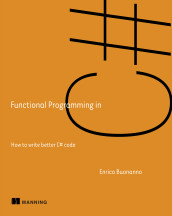
Functional Programming in C#, Second Edition
Error handling is the practice of detecting, representing, and responding to errors in a program.
- How it is used
- Represents possible failures as return values that callers can consume alongside successful results.
- How deep it goes
- Contrasts Option with richer outcomes and works through Try-based error handling in a stateful currency lookup.
- Examples
- Uses number parsing, collection lookup, money transfers, and a stateful currency-rate lookup.
- What you can do after
- Apply Option or Try to represent failures and handle them explicitly in calling code.
Read how Functional Programming in C#, Second Edition explains error handling →

gRPC Microservices in Go
Error handling is the practice of detecting, representing, and responding to failures during software execution or communication.
- How it is used
- Guides client decisions when gRPC communication between microservices fails.
- How deep it goes
- Works through status codes and Go validation-detail parsing, without descending into gRPC protocol internals.
- Examples
- Uses an Order service Create request with invalid fields and a ResourceExhausted order-limit response.
- What you can do after
- Apply it via Go gRPC status conversion to inspect validation errors and choose a response to service failures.

Secrets of the JavaScript Ninja, Second Edition
The practice of detecting and responding to errors that occur during program execution.
- How it is used
- Frames error handling as a callback weakness and a reason to use promise chains for asynchronous sequences.
- How deep it goes
- Compares try-catch limits around callbacks with Node-style error arguments and catch handling across a promise chain.
- Examples
- Uses nested ninja-data callbacks and a chained sequence of mission requests.
- What you can do after
- Understand why asynchronous callback timing can bypass surrounding try-catch and how chained catch handles earlier promise failures.
Read how Secrets of the JavaScript Ninja, Second Edition explains error handling →

Starting Data Analytics with Generative AI and Python
A technique for detecting, responding to, and recovering from software or service failures.
- How it is used
- Stabilizes generative AI integrations when requests encounter errors or timeouts.
- How deep it goes
- Recommends retries for timeouts and rate limits but gives no implementation steps.
- Examples
- Names timeouts and rate-limit errors as cases for retry handling.
- What you can do after
- Apply retry mechanisms to handle request timeouts and rate-limit errors.
Read how Starting Data Analytics with Generative AI and Python explains error handling →
Also covered in
- Rust Servers, Services, and Apps
- Software Engineering for Data ScientistsIn early access (MEAP)
- A Pythonic Adventure: From Python basics to a working web app
- Akka in Action, Second Edition
- Snowflake Data Engineering
- Write Powerful Rust Macros
- Build High Value Software SystemsIn early access (MEAP)
- 100 SQL Server Mistakes and How to Avoid Them
- Refactoring to Rust
- Building Web APIs with ASP.NET Core
- Build Financial Software with Generative AI (From Scratch)
- Effective Data Analysis
What to know first
- contractA contract is an agreed specification of the conditions, expectations, rights, or obligations that govern behavior or interactions between parties or software components.
- exceptionAn exception is a runtime signal or value representing an abnormal condition that interrupts ordinary program flow and can be handled or propagated.
- functionA function is a callable unit of program code that performs a computation or operation, can accept inputs, and may produce a result or side effect.
- PythonPython is a high-level, general-purpose, dynamically typed programming language with readable syntax and support for multiple programming paradigms.
Related concepts
- LangGraphused by · LangGraph is a framework for building stateful, graph-structured workflows and applications, including those involving language models and agents.
- exceptionuses · An exception is a runtime signal or value representing an abnormal condition that interrupts ordinary program flow and can be handled or propagated.
- error codeuses · An error code is a symbolic or numeric value that identifies or classifies an error or failure condition.
- result typeused by · A result type represents the outcome of an operation as either a successful value or a failure, often carrying information about either outcome.
Questions about error handling
What is error handling?
Error handling is the practice of detecting, representing, propagating, and responding to failures that arise during software execution or operation.
Which Manning books explain error handling?
Coding with AI, Systems Programming with Zig, Go in Action, Second Edition, Bootstrapping Microservices, Second Edition: With Docker, Kubernetes, GitHub Actions, and Terraform, Effective Conversational AI, Functional Programming in C#, Second Edition, gRPC Microservices in Go, Secrets of the JavaScript Ninja, Second Edition and 1 more.
What should I know before learning error handling?
Manning books that teach error handling usually introduce contract, exception, function and Python first.
What kinds of error handling are there?
Kinds of error handling include task error handling and zero-tolerance error handling.
These guides are generated from the text of Manning books by Manning's knowledge graph and link to the sections they draw on. The full books are available on liveBook and at manning.com.