Python
Python is a high-level, general-purpose, dynamically typed programming language with readable syntax and support for multiple programming paradigms.

The Quick Python Book, Fourth Edition
Python is a high-level general-purpose programming language with an interpreted execution model and dynamic features.
- How it is used
- Uses Python as a general-purpose language for rapid development, data processing, and larger applications.
- How deep it goes
- Moves from a syntax overview through built-in types, functions, classes, packages, exceptions, and a data-handling case study, without dwelling on advanced topics.
- Examples
- Uses variable conversion, a factorial loop, a type-checked addition function, and a file-counting program to illustrate language features.
- What you can do after
- Builds Python programs from language essentials and evaluates generated code against coding problems.
Read how The Quick Python Book, Fourth Edition explains Python →
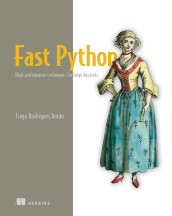
Fast Python: High performance techniques for large datasets
- How it is used
- Uses Python as the primary language for performance-conscious data processing and analysis.
- How deep it goes
- Explains profiling, object memory costs, concurrency limitations, and native-code alternatives, with measured comparisons.
- Examples
- Profiles NOAA station-distance calculations and compares Python and Cython Game of Life implementations.
- What you can do after
- Diagnose performance bottlenecks and evaluate optimizations against workload and hardware constraints.
Read how Fast Python: High performance techniques for large datasets explains Python →
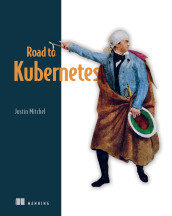
Road to Kubernetes
Python is a general-purpose, high-level programming language known for readable syntax and broad application support.
- How it is used
- Uses Python as a recurring web-application deployment case alongside JavaScript/Node.js.
- How deep it goes
- Works through application dependencies, Ubuntu setup, and runtime selection rather than comprehensive Python programming.
- Examples
- Uses a FastAPI application, Ubuntu setup commands, and a version-tagged Python container image.
- What you can do after
- Operate/configure a Python web app on Ubuntu with a virtual environment, or select and run a version-tagged Docker image.
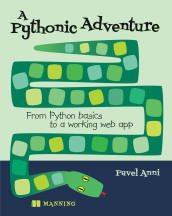
A Pythonic Adventure: From Python basics to a working web app
Python 3 is the third major version of the Python programming language.
- How it is used
- Introduces programming through a practical coffee-shop application and immediate interaction with a computer.
- How deep it goes
- Builds a first runnable program with print(), input(), variables, file naming, and editor execution, without advancing beyond basic interaction.
- Examples
- Uses a coffee-shop greeting, customer prompts, and a receipt listing a name, drink, flavor, and topping.
- What you can do after
- Build a small Python application that collects order details and prints a personalized receipt.
Read how A Pythonic Adventure: From Python basics to a working web app explains Python →

Get Programming: Learn to code with Python
A general-purpose, interpreted programming language with dynamic typing and significant standard-library support.
- How it is used
- Uses Python to teach programming basics before moving to interactive programs and structured-data tasks.
- How deep it goes
- Defines the interpreter and introduces objects and variables, then reaches aliasing and copying mutable objects.
- Examples
- Uses everyday object-naming analogies and dictionary exercises to make variable assignment and mutation concrete.
- What you can do after
- Build it from scratch by writing Python programs with variables, decisions, repetition, and reusable operations.
Read how Get Programming: Learn to code with Python explains Python →
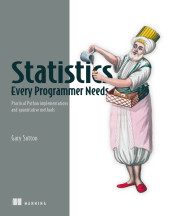
Statistics Every Programmer Needs
Python is a general-purpose programming language known for readable syntax and broad use in software development, data analysis, and scientific computing.
- How it is used
- Deploys Python as the analytical engine for preparing data, fitting models, simulating uncertainty, visualizing results, and supporting decisions.
- How deep it goes
- Demonstrates implementation through annotated examples and library workflows, but stops short of teaching Python syntax, installation, or general-purpose programming.
- Examples
- Uses pandas, NumPy, SciPy, Matplotlib, seaborn, scikit-learn, and statsmodels across regression, simulation, Markov chains, and data analysis.
- What you can do after
- Apply via Python libraries to implement quantitative methods, inspect results, and adapt reusable analytical code to real-world problems.
Read how Statistics Every Programmer Needs explains Python →
Practices of the Python Pro
Python is a general-purpose, high-level programming language known for readable syntax and a broad software ecosystem.
- How it is used
- Uses Python as a vehicle for learning software design, from utility scripts to complex software projects.
- How deep it goes
- Explains readable syntax, enterprise reach, REPL practice, design trade-offs, and dynamic typing, while deferring detailed language features.
- Examples
- Demonstrates Python through a REPL dictionary transformation, sorted state capitals, functions, modules, and refactored constants.
- What you can do after
- Evaluate/understand Python as a language for prototyping, interactive experiments, maintainable systems, and enterprise software.
Coding with AI
Python is a general-purpose, dynamically typed programming language commonly used for application development, automation, and data science.
- How it is used
- Uses Python to build small applications while introducing AI-assisted code completion and chat.
- How deep it goes
- Works through environments, file reading, text cleaning, generated alternatives, and revisions without presenting a broad language theory.
- Examples
- Demonstrates Python through a text-file word-counting application and project environments created from terminal commands.
- What you can do after
- Build it from scratch as a small Python application with AI-generated code and project-isolated dependencies.
Build a Robo-Advisor with Python (From Scratch)
A general-purpose, high-level programming language with dynamic typing and extensive support for scripting, data analysis, and application development.
- How it is used
- Automates robo-advising tasks such as asset allocation, tax-loss optimization, and Monte Carlo financial planning.
- How deep it goes
- Introduces Python’s flexible style and major libraries, then applies them to financial modeling rather than language internals.
- Examples
- Uses Social Security claiming break-even analysis and portfolio optimization, including tax-aware rebalancing and withdrawal strategies.
- What you can do after
- Build it from scratch: implement automated wealth-management analyses using Python libraries and stated financial assumptions.
Read how Build a Robo-Advisor with Python (From Scratch) explains Python →
Build Financial Software with Generative AI (From Scratch)
Python is a general-purpose, dynamically typed programming language with a concise syntax and an extensive standard library.
- How it is used
- Uses Python as the primary language for new projects in an ACH dashboard modernization initiative.
- How deep it goes
- Develops a balance example from printing to a typed function, while leaving backend technologies for deeper investigation.
- Examples
- Refines a generated balance-printing program to accept input, format currency, and return a string from a function.
- What you can do after
- Builds a simple balance-formatting function and uses Python with FastAPI for backend processing.
Read how Build Financial Software with Generative AI (From Scratch) explains Python →

Python How-To
Python is a high-level programming language with dynamic semantics and extensive support for readable application code.
- How it is used
- Builds transferable Python skills for practical projects before applying domain-specific tools.
- How deep it goes
- Explains practical language characteristics and selected syntax examples while prioritizing essential skills over exhaustive coverage.
- Examples
- Demonstrates membership checks on lists, strings, and tuples and reassignment of a type-hinted variable.
- What you can do after
- Evaluate Python for practical tasks and apply core features with readability and maintainability in mind.

The Well-Grounded Python Developer: How the pros use Python and Flask
Python 3 is the third major version line of the Python programming language.
- How it is used
- Build maintainable applications by combining Python with modules, conventions, community knowledge, and third-party packages.
- How deep it goes
- Explains Python's development role, paradigms, version choice, and maintainability concerns without teaching syntax or implementation internals.
- Examples
- Uses reusable modules, class-based applications, first-class functions, event-driven programs, and Python 3.10.3 as concrete reference points.
- What you can do after
- Evaluate/understand Python's role, select Python 3 for new projects, and recognize when another language may better fit a domain.
Read how The Well-Grounded Python Developer: How the pros use Python and Flask explains Python →
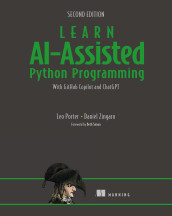
Learn AI-Assisted Python Programming, Second Edition
Python is a high-level, general-purpose programming language designed for readable syntax and broad application development.
- How it is used
- Uses Python as the readable programming language for AI-assisted creation of practical software.
- How deep it goes
- Introduces syntax, execution, errors, and interactive experimentation, while deferring detailed code reading and low-level implementation.
- Examples
- Demonstrates number ranges, addition, square areas, syntax errors, and calculations in the Python REPL.
- What you can do after
- Apply it via Visual Studio Code and the Python REPL to run small programs, inspect results, and check AI-generated code.
Read how Learn AI-Assisted Python Programming, Second Edition explains Python →
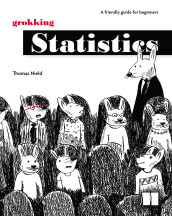
Grokking Statistics
Python is a general-purpose, high-level programming language with dynamic typing and extensive support for scientific and data-oriented computing.
- How it is used
- Supports statistical analysis, data handling, visualization, and machine-learning workflows.
- How deep it goes
- Introduces practical calculations, libraries, and projects while stopping short of detailed language internals.
- Examples
- Uses employee polling, retail spending, educational testing, and house-price prediction as applied data examples.
- What you can do after
- Apply it via NumPy, pandas, and Matplotlib to perform practical statistical and data-analysis tasks.

Python Workout: 50 ten-minute exercises
Python 3 is the major version of the Python programming language in which input returns text entered by the user.
- How it is used
- Uses Python for input-driven programs, numeric processing, accumulation, reporting, and broader problem solving.
- How deep it goes
- Demonstrates conversions, loops, accumulation, comparisons, and formatting through exercises, while stopping short of language internals.
- Examples
- Uses a run-timing average, a number-guessing interaction, and contrasting assignment forms inside input loops.
- What you can do after
- Apply Python to break problems down, choose constructs, compare trade-offs, and write readable, Pythonic solutions.
Read how Python Workout: 50 ten-minute exercises explains Python →
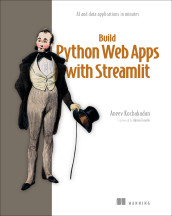
Build Python Web Apps with Streamlit
Python is a general-purpose, high-level programming language widely used for software development and artificial intelligence.
- How it is used
- Builds Streamlit interfaces and data-oriented applications without requiring separate HTML, CSS, and JavaScript development.
- How deep it goes
- Demonstrates files, imports, variables, conversion, context managers, widgets, and reruns through an incremental interface, not language internals.
- Examples
- Uses a Streamlit unit converter with radio buttons, text input, dropdowns, columns, a sidebar, and a conversion button.
- What you can do after
- Build a small browser-based interface, run it with Streamlit, and connect user controls to Python variables.
Read how Build Python Web Apps with Streamlit explains Python →
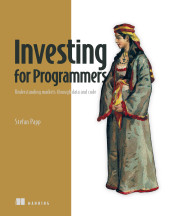
Investing for Programmers
Python is a general-purpose programming language with a large ecosystem for data analysis and scientific computing.
- How it is used
- Integrates LLM prompting into financial research workflows, notebooks, and AI-agent development.
- How deep it goes
- Demonstrates provider calls, prompt parameters, model selection, and local execution without detailing Python language fundamentals.
- Examples
- Uses OpenAI, Gemini, Anthropic, Mistral, and Hugging Face prompt-submission examples.
- What you can do after
- Build Python scripts that submit prompts, configure generation, process responses, or invoke locally downloaded models.

Python Workout, Second Edition
Python is a general-purpose, high-level programming language known for readable syntax and broad application support.
- How it is used
- Supports readable problem solving, automation, data work, web development, testing, operations, research, and security.
- How deep it goes
- Develops fluency through exercises in core structures and program organization, while leaving continuing libraries, techniques, and language nuances for further practice.
- Examples
- Uses exercises with core data structures, recurring-task automation, solution comparison, and open-source contribution as practice contexts.
- What you can do after
- Apply Python to break down unfamiliar problems, select suitable constructs, write readable code, and automate recurring tasks.

Data Without Labels
Python is a general-purpose, high-level programming language widely used for software development, data analysis, and machine learning.
- How it is used
- Uses Python to build reproducible data-analysis and unsupervised machine-learning workflows around concrete business problems.
- How deep it goes
- Walks through data preparation, text processing, sentiment scoring, visualization, and interpretation, without developing Python language internals.
- Examples
- Demonstrates Python through telecom and product-review analysis using pandas, NLTK, TextBlob, matplotlib, and scikit-learn.
- What you can do after
- Build reproducible Python workflows that load, clean, analyze, visualize, and score review data for machine-learning use cases.
Refactoring to Rust
Python is a high-level general-purpose programming language commonly implemented with automatic memory management and garbage collection.
- How it is used
- Uses Python for rapid prototyping, research, machine learning, data mining, and production applications.
- How deep it goes
- Explains syntax, interpretation, typing, allocation, native integration, and one measured performance comparison, but defers full runtime internals.
- Examples
- Uses CSV column aggregation, Python extension modules, and computationally expensive asynchronous applications as concrete examples.
- What you can do after
- Evaluate Python bottlenecks with benchmarking and profiling, then apply Rust integration or extensions to performance-critical paths.
Learn AI Data Engineering
Python is a general-purpose programming language widely used for automation, data processing, and artificial-intelligence applications.
- How it is used
- Applies Python to API work, regex parsing, and data-engineering transformations with AI assistance.
- How deep it goes
- Works through runnable regex and cleaning tasks, while deferring broader Python language fundamentals.
- Examples
- Uses phone-number extraction, brewery API cleanup, and surf-shop order validation examples.
- What you can do after
- Apply it via Jupyter Notebook, pandas, regex, and a coding companion to clean and analyze data.
Build Applications with Local AI Models on a Mac
A high-level general-purpose programming language known for readable syntax and a broad software ecosystem.
- How it is used
- Uses Python to connect local AI model interactions with application interfaces.
- How deep it goes
- Introduces development setup and programming vocabulary, then builds Python skills progressively through applications.
- Examples
- Uses a Streamlit chatbot with streaming responses, conversation history, and voice input.
- What you can do after
- Apply it via Streamlit to build a chatbot and manage an isolated project environment.
Read how Build Applications with Local AI Models on a Mac explains Python →

DuckDB in Action
Python is a high-level general-purpose programming language with a dynamic runtime and extensive support for data processing.
- How it is used
- Integrates DuckDB into Python workflows for file ingestion, relational querying, data interchange, and pipeline transformations.
- How deep it goes
- Explains Python ingestion and queryable relations with runnable operations, while deferring SQLAlchemy and broader persistence patterns.
- Examples
- Uses a remote Populations CSV, httpfs, DuckDBPyRelation inspection, SQL execution, counting, and relation-to-table conversion.
- What you can do after
- Apply it via DuckDB's Python API to ingest files, query Python-accessible data, transform results, and feed data pipelines.
The Complete Obsolete Guide to Generative AI
Python is a general-purpose programming language commonly used for scripting, automation, and software development.
- How it is used
- Turns Playground prompt experiments into portable API code that can be copied, run, and adapted.
- How deep it goes
- Demonstrates generated API code and targeted learning prompts, while deferring Python syntax and API argument details.
- Examples
- Uses generated Completion API code, list iteration questions, and MoviePy-based 4K-to-1080p video conversion.
- What you can do after
- Apply it via the OpenAI API by copying configured Playground code and adapting it for a task.
Read how The Complete Obsolete Guide to Generative AI explains Python →
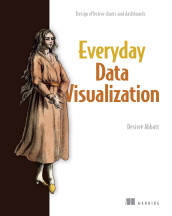
Everyday Data Visualization
Python is a general-purpose programming language known for readable syntax and a broad ecosystem of libraries.
- How it is used
- Positions Python as an approachable language for data visualization practitioners who prefer it over JavaScript or R.
- How deep it goes
- Demonstrates library selection and a short chart example, but stops short of teaching Python syntax or detailed implementation.
- Examples
- Uses fruit data and an approximately 18-line Matplotlib bar-chart example.
- What you can do after
- Apply it via Matplotlib to create a simple bar chart from supplied data.
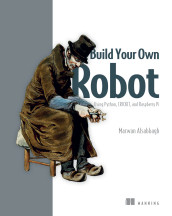
Build Your Own Robot: Using Python, CRICKIT, and Raspberry Pi
Python is a high-level, general-purpose programming language commonly used for automation, data processing, and application development.
- How it is used
- Powers incremental robot projects by connecting Linux software libraries with sensors, motors, cameras, and user interfaces.
- How deep it goes
- Descends from stack placement and environment setup to hardware interfaces, reusable motor functions, and a Python shell.
- Examples
- Uses LEDs, touch sensors, motor movement, robot shells, computer vision, QR-code detection, and network control as practical applications.
- What you can do after
- Build it from scratch by configuring Python, installing libraries, and writing applications that operate robot hardware and interfaces.
Read how Build Your Own Robot: Using Python, CRICKIT, and Raspberry Pi explains Python →
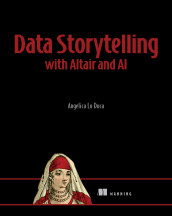
Data Storytelling with Altair and AI
Python is a general-purpose, high-level programming language widely used for data analysis and scientific computing.
- How it is used
- Uses Python for data analysis, visualization, storytelling, and reporting across the data science project life cycle.
- How deep it goes
- Explains Python through visualization workflows and reporting integration, stopping short of general language internals or syntax instruction.
- Examples
- Demonstrates square-number line charts through contrasting Matplotlib and Altair implementations.
- What you can do after
- Apply Python to build visualizations and reports without repeatedly transferring analyzed data into external tools.
Read how Data Storytelling with Altair and AI explains Python →
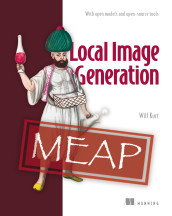
Local Image Generation
Python is a general-purpose programming language with an interactive interpreter and extensive standard-library support.
- How it is used
- Uses Python to automate Stable Diffusion generation, access newer models, and build customized workflows.
- How deep it goes
- Explains notebook-based scripting and code modification, but defers deeper customization and model training.
- Examples
- Uses notebooks, copied programs, varied prompts and settings, graphic-novel pages, and collections of generated images.
- What you can do after
- Apply it via Jupyter notebooks and Hugging Face Diffusers to automate repeated Stable Diffusion image-generation tasks.
Also covered in
- Pandas Workout: 200 exercises to make you a stronger data analyst
- LLMs in Production
- GPU Programming with TritonIn early access (MEAP)
- Deep Learning with R, Third Edition
- Deep Learning with Python, Third Edition
- Spring Microservices in Action
- Infrastructure as Code, Patterns and Practices: With examples in Python and Terraform
- Privacy-Preserving Machine Learning
- Secure APIs
- Effective Data Analysis
- Fight Fraud with Machine LearningIn early access (MEAP)
- Data Pipelines with Apache Airflow, Second Edition
What to know first
- machine learningMachine learning is a field of computational methods in which systems learn patterns or relationships from data to make predictions, decisions, or other outputs.
- language modelA language model is a computational model that represents patterns in linguistic sequences to assign probabilities, predict, generate, or evaluate language.
- programming languageA programming language is a formal language with defined syntax and semantics for expressing computations and instructions that a computer can execute, interpret, or translate.
Related concepts
- programming languagekind of · A programming language is a formal language with defined syntax and semantics for expressing computations and instructions that a computer can execute, interpret, or translate.
- Matplotlibuses · Matplotlib is an open-source Python library for creating static, animated, and interactive data visualizations.
- Streamlitused by · Streamlit is an open-source Python framework for building interactive web applications, particularly for data and machine-learning applications.
Questions about Python
What is Python?
Python is a high-level, general-purpose, dynamically typed programming language with readable syntax and support for multiple programming paradigms.
Which Manning books explain Python?
The Quick Python Book, Fourth Edition, Fast Python: High performance techniques for large datasets, Road to Kubernetes, A Pythonic Adventure: From Python basics to a working web app, Get Programming: Learn to code with Python, Statistics Every Programmer Needs, Practices of the Python Pro, Coding with AI and 20 more.
What should I know before learning Python?
Manning books that teach Python usually introduce machine learning, language model, Java and programming language first.
What is Python a kind of?
Python is a kind of programming language. A programming language is a formal language with defined syntax and semantics for expressing computations and instructions that a computer can execute, interpret, or translate.
These guides are generated from the text of Manning books by Manning's knowledge graph and link to the sections they draw on. The full books are available on liveBook and at manning.com.