Python is used to turn wealth-management decisions into repeatable programs. Its approachable syntax, optional object-oriented style, and optional type hints let practitioners begin simply while retaining room for more sophisticated implementations. Extensive documentation and broad adoption also make practical problem-solving easier. section 1.4
For robo-advising, Python supplies the implementation layer for algorithms that automate functions otherwise performed by human advisors. It supports applications from asset allocation and tax-loss optimization to Monte Carlo financial planning, helping deliver customized analysis without equivalent manual effort. section 1.1 section 1.6
Its numerical ecosystem supports distinct parts of a financial workflow:
- NumPy provides numerical computing, including vector and matrix operations, linear-system least squares, random generation, and matrix factorizations. section 1.4
- SciPy provides optimization, integration, root-finding, and statistical algorithms. section 1.4
- pandas makes data manipulation easier by adding abstraction over arrays and matrices. section 1.4
- CVXPY expresses and solves convex optimization problems with readable mathematical syntax; statsmodels can run linear regression in a few lines. section 1.4
Extending a Social Security decision
A simple break-even comparison can estimate whether claiming Social Security at 62 or 70 has greater present value for a given lifespan. Python becomes more valuable when the decision must incorporate spouses, detailed rules, projected earnings, downloaded records, asset allocation, taxes, and benefit withholding. The output remains conditional on inputs and assumptions rather than a guaranteed recommendation. section 1.3
Figure 1.2 Break-even analysis on the age to start claiming Social Security
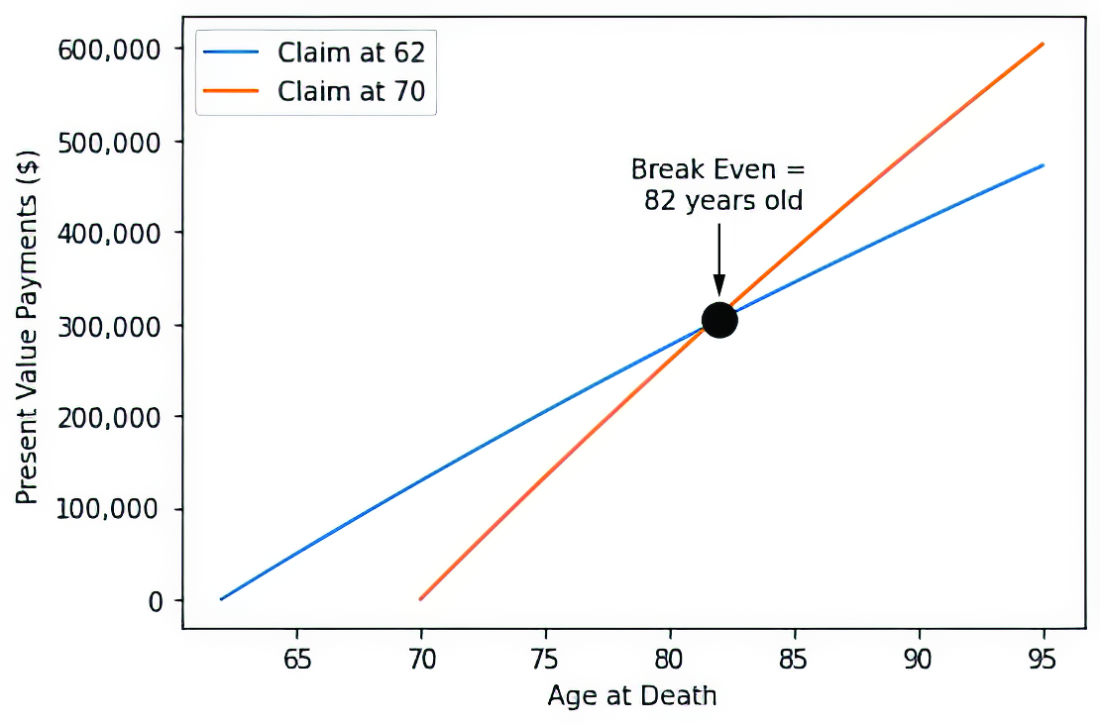
The break-even chart gives a small numerical starting point: claiming later wins after the crossover age, before broader rules and personal constraints are modeled in code. section 1.3
Optimization illustrates the practical pattern: formulate a financial objective and constraints, solve it with Python libraries, then inspect weaknesses in the result. Portfolio construction, tax-aware rebalancing, and withdrawal strategies can be solved quickly after implementation, but optimization pitfalls motivate more advanced methods. section 10.0

























