Absolute error measures how well a fitted line matches observed points by adding the absolute vertical distance from each point to the line. Absolute values make every distance positive, whether a prediction is above or below its observed value. section 3.20 section 3.21
Use absolute error to compare candidate regression lines:
- Calculate each difference between the observed label and predicted label. section 3.21
- Take the absolute value of every difference so all distances are positive. section 3.21
- Add the distances; prefer the line with the smaller total. section 3.21
Choosing between two lines
Suppose two lines try to fit the same points. One line lies close to a few points but far from several others; the other stays reasonably close to all of them. The second line has the smaller absolute error and is preferred. section 3.21
Figure 3.18 The absolute error is the sum of the vertical distances from the points to the line. Note that the absolute error is large for the bad model on the left and small for the good model on the right.
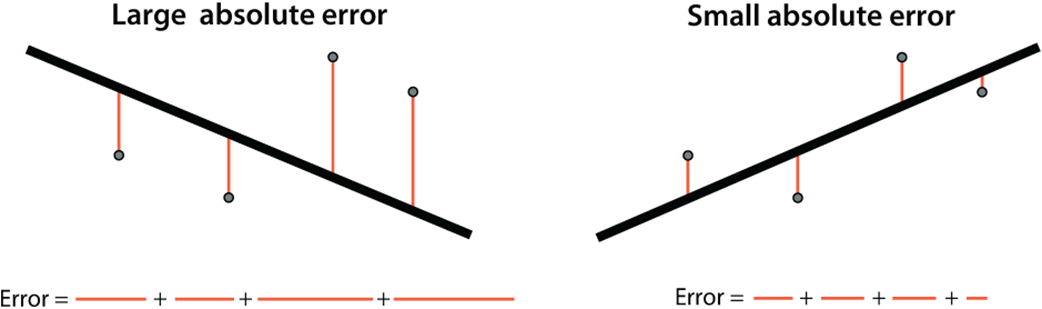
Compare the large and small absolute-error models through their vertical distances from the data points. section 3.21
Absolute error is useful for explaining linear regression, while mean absolute error is more common in practice because averaging makes results comparable across datasets of different sizes. section 3.23


