liveBook · Manning

Abstract ui

As explained in Test Driven: Practical TDD and Acceptance TDD for Java Developers

An abstract UI is a test-facing interface that represents user interactions without depending on concrete, technology-specific widgets.

An abstract UI gives acceptance tests an alternative way to interact with a system without coupling them to concrete, technology-specific widgets. By reaching application or domain logic through this interface, tests can be less vulnerable to changes in the visible UI. section 11.2.2

Tests can reach a system through different channels, depending on its architecture:

  • Use the external UI. section 11.2.2
  • Use an abstract UI or an internal service-layer API. For a weblog, fixture examples include a remote JNDI lookup and a direct Java API call from the same JVM. section 11.2.2
Figure 11.3. Test operating against an internal API or an abstract UI in addition to or instead of the real UI
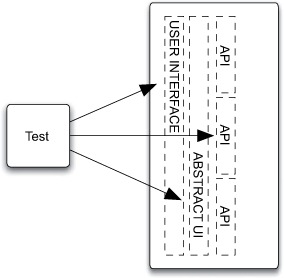
Compare the external UI, abstract UI, and internal API as test access channels. section 11.2.2

How Test Driven: Practical TDD and Acceptance TDD for Java Developers covers it

How deep it goes
Defines the approach, explains its maintenance benefit, and gives access-channel examples without detailing an abstract UI implementation.
Examples
Uses weblog test fixtures with remote JNDI lookup and direct Java service-layer calls.
What you can do after
Evaluate which test access channel fits an application's architecture.
How it connects
Connects acceptance testing with end-to-end testing, application logic, domain logic, and internal service APIs.

Related concepts

This explainer was generated by Manning's knowledge graph from the text of Test Driven: Practical TDD and Acceptance TDD for Java Developers. The section links point to the parts of the book it draws on.