liveBook · Manning

Crawling under the skin

As explained in Test Driven: Practical TDD and Acceptance TDD for Java Developers

Crawling under the skin is an acceptance-testing strategy that bypasses a system’s concrete user interface to test through an abstract interface or internal functionality.

Acceptance tests can reach a system without relying on its concrete user interface. They can use an abstract interface or call application, domain, or service-layer functionality directly, reducing dependence on UI widgets that may change. section 11.2.2

Possible routes depend on the system’s architecture:

Two ways into a weblog application

A fixture can use JNDI to reach a remote application server’s internal API, or call the service layer directly through Java when tests run in the same JVM. section 11.2.2

Figure 11.3. Test operating against an internal API or an abstract UI in addition to or instead of the real UI
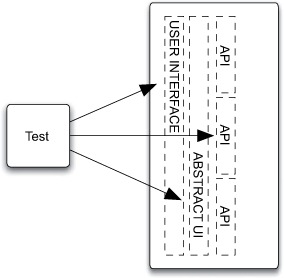
Shows tests reaching an abstract UI or internal API as alternatives to, or alongside, the external UI. section 11.2.2
How Test Driven: Practical TDD and Acceptance TDD for Java Developers covers it

How deep it goes
Distinguishes external UI, abstract UI, and internal service APIs, with weblog examples using remote JNDI and direct Java calls.
Examples
Uses a weblog’s remote JNDI lookup and same-JVM service-layer call to exercise internal functionality.
What you can do after
Apply it by routing acceptance tests through an abstract UI or accessible internal API instead of concrete UI widgets.
How it connects
Connects acceptance testing with end-to-end testing, user interfaces, application and domain logic, and service-layer APIs.

Related concepts

This explainer was generated by Manning's knowledge graph from the text of Test Driven: Practical TDD and Acceptance TDD for Java Developers. The section links point to the parts of the book it draws on.