Abstractive question answering generates an answer by synthesizing information from one or more ranked search results. Unlike extractive question answering, it may rewrite, combine, and interpret information rather than returning wording copied directly from a document. section 1.3.5 section 15.2
The distinction from neighboring search techniques is operational:
- Extractive question answering finds and returns exact answer-bearing passages from documents. section 14.0
- Abstractive question answering interprets ranked results and writes a new response, potentially combining multiple documents. section 1.3.5
- Results summarization condenses search results, while abstractive question answering targets a direct response to a user’s question. section 1.3.5 section 15.2
From ranked pages to a synthesized response
A query such as “What is an optimal agenda for three days in Paris assuming I really like fine dining, historic buildings and museums, but hate crowds?” can drive a generated response that combines information from dynamically analyzed search results instead of returning ten links for the user to interpret. section 15.2
Figure 1.11 The transition from traditional information retrieval to generative search
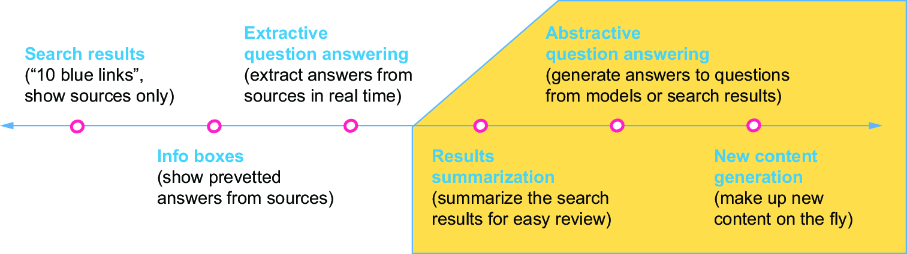
Use the transition diagram to place abstractive question answering between traditional retrieval, extractive answers, and broader generative search. section 1.3.5
