Generative search creates responses from search results instead of returning only existing documents. It extends traditional ranked links and extractive answers toward synthesized summaries and answers. section 1.3.5 section 15.2
A typical flow retrieves and ranks relevant content, then uses a large language model to summarize multiple results or answer a question by synthesizing them. Retrieval-augmented generation supplies current context to reduce unsupported answers. section 1.3.5 section 1.4
Generative search commonly supports:
- Results summarization, which rewrites several ranked results into a concise response and can include citations. section 1.3.5 section 15.2
- Abstractive question answering, which generates an answer by synthesizing information from one or more search results. section 1.3.5 section 15.2
- Conversational and multimodal search experiences built with foundation models. section 15.0
Planning a personalized trip
For “What is an optimal agenda for three days in Paris assuming I really like fine dining, historic buildings and museums, but hate crowds?”, generative search can synthesize a tailored response from dynamically analyzed results. That flexibility also creates risks when generated responses reflect political or commercial bias, censorship, propaganda, or inaccurate synthesis. section 15.2
Figure 15.2 Spectrum of traditional search approaches (left) to generative search (right)
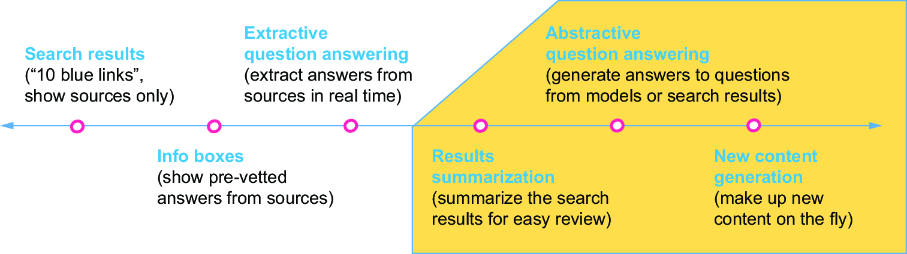
Use the spectrum diagram to compare traditional ranked links, predetermined answers, extractive question answering, results summarization, and abstractive question answering. section 15.2
