ACME (Automated Certificate Management Environment) automates X.509 certificate issuance and certificate-authority validation of domain control. It replaces difficult manual verification with API-driven challenges, enabling short-lived certificates and automatic renewal. section 9.0 section 9.1.3
An HTTP-01 validation exchange works as follows:
- The requester sends a certificate signing request (CSR) to the certificate authority over HTTPS. section 9.1.3
- The authority returns a challenge and small file for a specified website URL. section 9.1.3
- The requester publishes the file and tells the authority it is available. section 9.1.3
- The authority fetches the URL from multiple locations; successful retrieval proves control and permits issuance. section 9.1.3
Figure 9.6 Domain validation via HTTP challenge. This flow illustrates how a CA validates domain ownership using an HTTP challenge. The requester sends a CSR, receives a challenge file from the CA, and places it at a specific location on their website. When the CA finds the file at that location, it confirms domain control and issues the certificate.
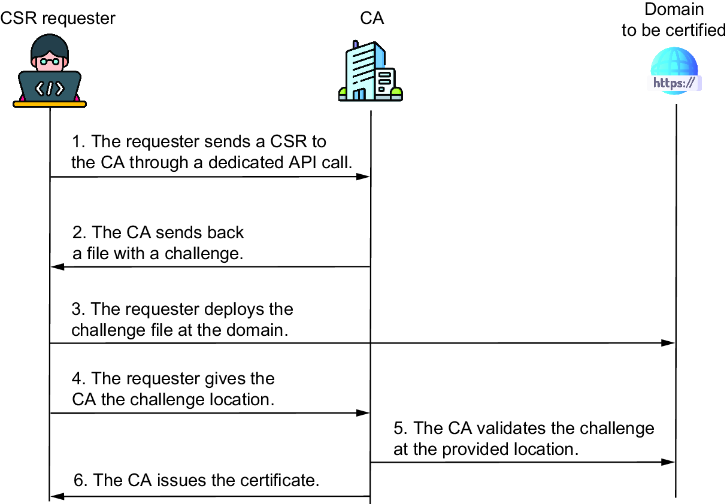
The HTTP challenge flow makes the trust boundary visible: control of the website is demonstrated before certificate issuance. section 9.1.3
