Acquisition is the marketing and sales process of turning prospective customers into engaged or paying customers. It is the front end of the customer journey, where audience insight, channel choice, and conversion activity must work together. section 3.3.2
First-party data makes acquisition more precise by revealing customer preferences and behaviors. Teams can refine audience models, focus on high-intent prospects, improve return on ad spend, and reduce acquisition costs. section 1.6.1
An acquisition strategy can combine several complementary moves:
- Build and continuously refine data-driven audiences to improve targeting accuracy and prioritize prospects most likely to convert. section 1.6.1
- Use multistep journeys to educate prospects, personalize channel engagement, and move qualified leads toward conversion or sales referral. section 3.3.2
- Optimize costs by trying email and mobile notifications before activating paid media when lower-cost channels fail to convert. section 3.3.2
A staged acquisition journey
A company may begin with a targeted audience of prospective customers, send educational messages over several steps, and escalate to conversion-oriented messaging or a sales referral when lead scores reach defined thresholds. section 3.3.2
Figure 1.4 Funnel stages of first-party data-driven marketing
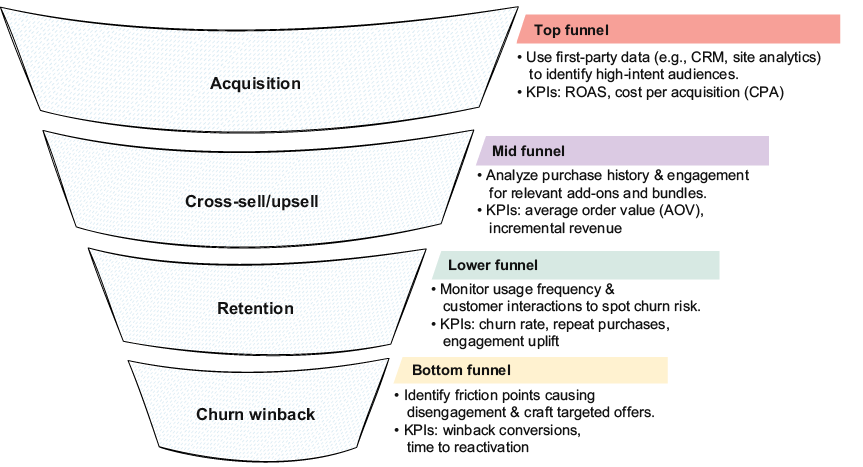
Use the funnel to connect acquisition with later stages such as onboarding, retention, cross-sell, upsell, and churn winback. section 1.6.1
