An actual world is the possible world whose event outcomes were observed. In a causal model, it is the way the data-generating process unrolled to produce the available data, unlike hypothetical worlds, which represent unobserved alternatives. section 8.4.1
The actual world anchors counterfactual reasoning. Potential outcomes describe the same variable across differing worlds, while the law of consistency makes an unaltered hypothetical world mirror the observed actual world. An intervention can break that correspondence downstream, allowing hypothetical outcomes to differ. section 8.4.1 section 9.1.3
From observed evidence to a hypothetical intervention
Suppose observed evidence includes low engagement and an intervention sets an input to 50. In a structural causal model, information learned from the actual-world observations updates exogenous-variable distributions, which are then propagated into the intervened hypothetical world. Variables downstream of the intervention may differ from their actual-world values. section 9.1.3
Figure 9.6 Paths for inferring the hypothetical distribution of I from the conditional distribution P(NG, NE, NI| E=“low”, I=50) on the exogenous variables, given the observed actual world outcomes
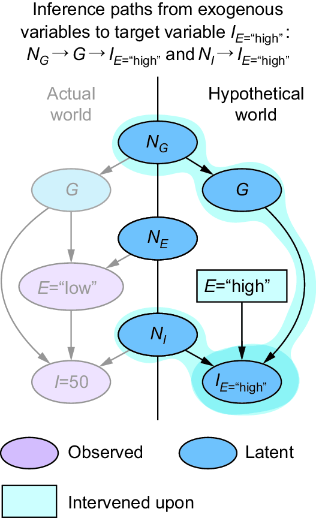
Figure 9.6 traces inference from exogenous variables conditioned on actual-world observations to a hypothetical variable after intervention. section 9.1.3
