A possible world is a way the world is or could be. In causal reasoning, the actual world contains observed outcomes, while hypothetical worlds represent alternative ways a data-generating process could have unfolded. section 8.4.1
Counterfactual analysis distinguishes related kinds of worlds and outcomes:
- Actual world: the possible world produced by the observed unfolding of the data-generating process. section 8.4.1
- Hypothetical world: a possible world with unobserved event outcomes, often created by changing a condition through intervention. section 8.4.1 section 8.4.3
- Potential outcomes: outcomes of the same variable across different possible worlds. section 8.4.1
- Parallel worlds: a set of possible worlds sharing common and differing attributes, represented for counterfactual queries by a parallel world graph. section 8.4.1
A hypothetical condition is modeled with an ideal intervention. Graph surgery removes incoming edges to the intervened variable, allowing downstream outcomes to differ from those in the actual world. In structural causal models, exogenous variables determine hypothetical-world values; observed actual-world information is propagated into the intervention-defined world. section 8.4.3 section 9.1.3
Changing engagement in an online game
Suppose engagement was low and in-game purchases equaled 50. A counterfactual question asks what purchases might have been if engagement had been high. Intervening on engagement creates a hypothetical world where its incoming causes are removed, so the purchase outcome can differ from the observed outcome. section 8.4.3
Figure 8.16 The graph representing the possible world with the hypothetical conditional is simpler than the graph representing the actual world.
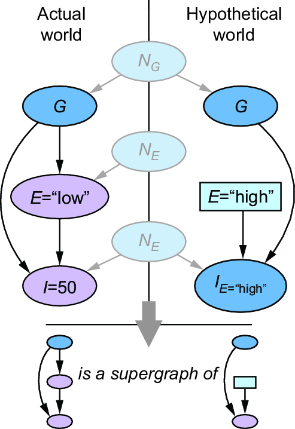
Use the graph comparison to see why an intervention-defined hypothetical world can be simpler than the actual world: its edges may form a subset of the actual world's edges. This descending complexity is an algorithmic rule of thumb for reducing instability. section 8.4.5
