An acyclic graph contains no cycle: starting at any node, you cannot return to it by following edges without backtracking. Its structure often resembles a tree or a non-looping path. A directed acyclic graph (DAG) is the directed form, with one-way edges and no cycles, useful for causal structures, workflows, and dependency chains. section 1.2.2
Distinguish the related forms:
- A cyclic graph permits a path that returns to its starting node without retracing edges. section 1.2.2
- An acyclic graph may be undirected or directed, provided no cycle is possible. section 1.2.2
- A DAG restricts the graph to directed edges, representing relationships that cannot flow back to their starting point. section 1.2.2
Figure 1.4 A cyclic graph (left), an acyclic graph (right), and a DAG (bottom). In the cyclic graph, the cycle is shown by the arrows (directed edges) connecting nodes A-E-D-C-B-A. Note that two nodes, G and F are part of the graph, but not part of its defining cycle. The acyclic graph is composed of undirected edges, and no cycle is possible. In the DAG, all directed edges flow in one direction, from A to F.
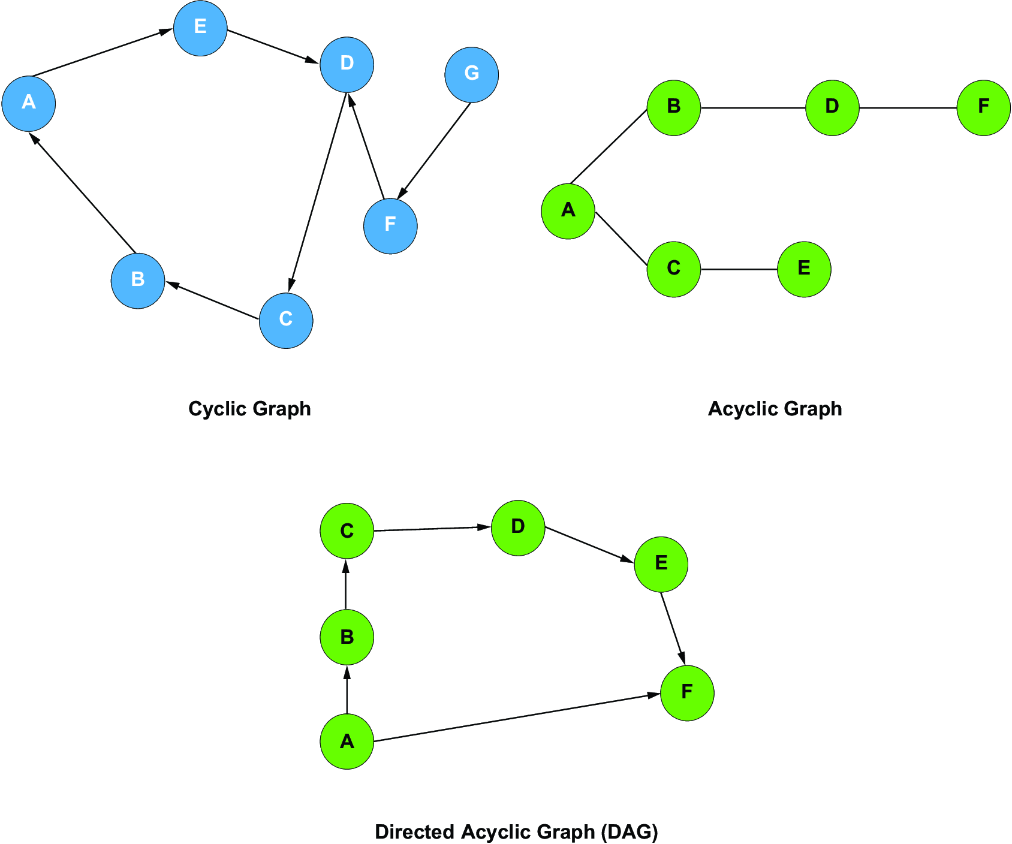
Compare a cyclic graph, an undirected acyclic graph, and a DAG; the diagrams make the absence of cycles and direction constraints visible. section 1.2.2


