Adaptability is the ability to face unexpected conditions, adjust behavior, and learn from new information. It separates intelligence from automation: automation follows situations anticipated during training or programming, while an adaptable agent can respond beyond them. section 1.10
Deep learning models often struggle with novelty because their parameters are fixed after training. At inference time, they retrieve patterns from past data and may fail when situations fall outside that distribution. section 19.1.1
Adaptability becomes visible when a system encounters conditions unlike those represented in its training experience:
- A model trained on ImageNet may classify a leopard-print sofa as a leopard because sofas were absent from its training data. section 19.1.1
- Large language models may reuse memorized text-processing patterns successfully, yet become helpless when a problem has no direct equivalent in their training data. section 19.1.1
Novelty as a test
An easy puzzle can still expose weak adaptability if it presents a configuration not directly represented in training data. Solving such a problem requires more than retrieving a familiar pattern. section 19.1.1
Figure 19.1 An easy yet novel puzzle
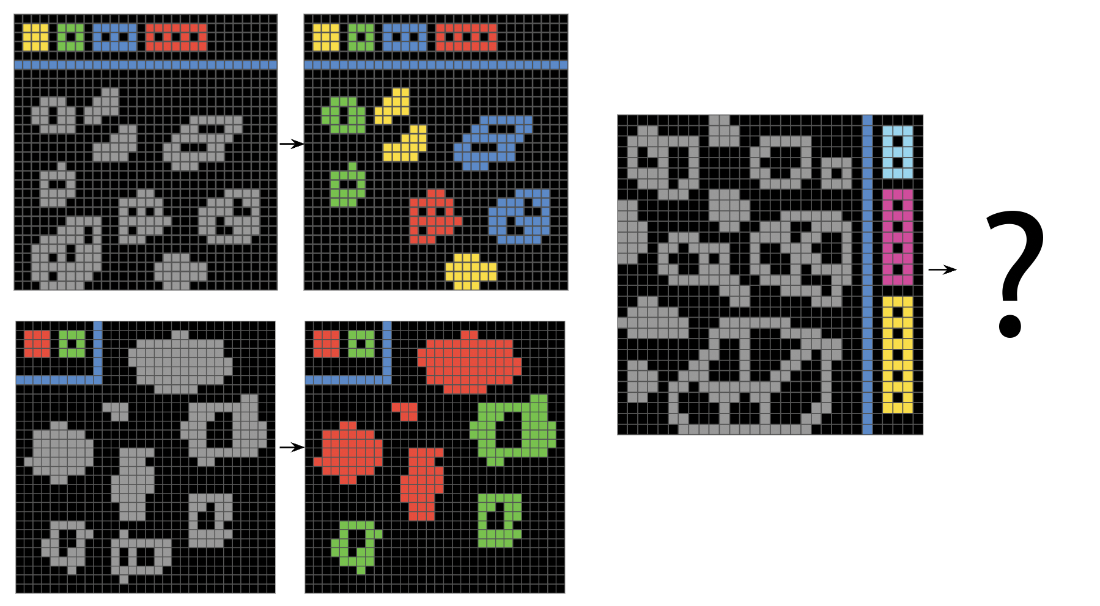
Use the figure as a concrete reference for a novel puzzle that challenges pattern retrieval. section 19.1.1




