Use the addition rule when an outcome can come from one of several mutually exclusive alternatives. Count the possibilities in each alternative, then add the counts. For events that cannot occur together, add their individual probabilities to find the probability of either event: P(A or B) = P(A) + P(B). Check that the alternatives do not overlap before adding. section 2.2.2
Choose the rule by asking what can happen in one trial:
- One action or the other: flipping a coin offers 2 outcomes; rolling a die offers 6. If only one action is performed, there are 2 + 6 = 8 possible action-and-result outcomes. This is a count, not a probability. section 2.2.2
- Both actions: flipping a coin and rolling a die produces combinations of results, so multiply 2 × 6. Independent events occurring together call for the multiplication rule, not this count of alternatives. section 2.2 section 2.2.2
Two dice: a sum of 7 or 11
A roll cannot have both sums, so their probabilities can be added. Enumerate the 36 ordered pairs and check each count before calculating the result: pairs = [(a, b) for a in range(1, 7) for b in range(1, 7)] seven = sum(a + b == 7 for a, b in pairs) eleven = sum(a + b == 11 for a, b in pairs) print(seven, eleven, len(pairs)) # 6 2 36 print(f'{(seven + eleven) / len(pairs):.4f}') # 0.2222 Thus P(sum is 7 or 11) = 6/36 + 2/36 = 8/36, about 22.2%. The separate counts validate the numerator; mutual exclusivity justifies adding them. section 3.2.3
The same idea accumulates probabilities in a discrete cumulative distribution function: P(X ≤ x) sums the probabilities of eligible values. For two dice, the probabilities of sums 2, 3, and 4 add to P(X ≤ 4) ≈ 0.167. When an event includes many values, computing its complement may be simpler than adding every case. section 2.4.3 section 3.2.3
Figure 2.5 The CDF for rolling a pair of six-sided dice. The shape of the distribution resembles a two-dimensional flight of stairs in which the horizontal line segments represent consecutive values for x and the vertical lines represent their respective probabilities.
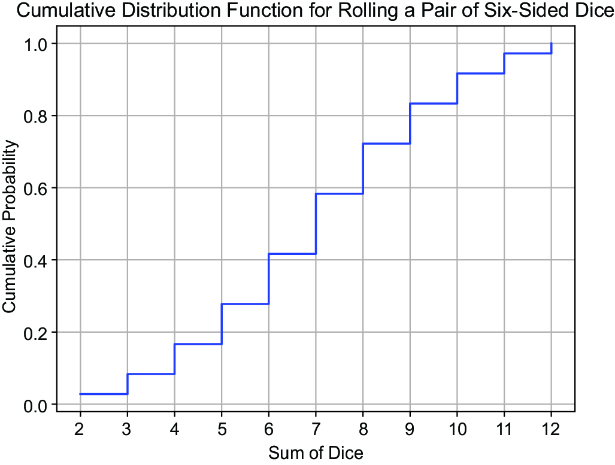
The two-dice CDF plot shows successive probabilities accumulating into a step-shaped total. section 2.4.3
