When the causal question is how an intervention changes an outcome, an additive structural causal model (SCM) represents each variable as a function of its direct endogenous causes plus an exogenous disturbance. For a protein quantity Y caused by enzyme amount X, write N_Y ~ P(N_Y) and Y := f_Y(X) + N_Y. The function describes the systematic causal effect; the disturbance captures additional exogenous influence. Additive models provide a practical starting point because their parameters often have causal interpretations and can be learned with established software. section 6.4.3
Common additive SCM templates combine a constraint on the assignment function with one on the exogenous-variable distribution:
- LiGAM uses a linear assignment with Gaussian additive disturbances. section 6.4.3
- LiNGAM uses a linear assignment with non-Gaussian additive disturbances. section 6.4.3
- The nonlinear additive noise model (ANM) permits nonlinear assignments while retaining additive noise. section 6.4.3
Fit assignment-function parameters with linear or nonlinear regression tools, including generalized least squares, then inspect goodness-of-fit statistics. Unlike ordinary regression, an SCM restricts predictors to direct endogenous causes rather than adding any variables that improve prediction. A generalized linear model may resemble an additive SCM, but its link function is designed around a canonical distribution’s mean, not necessarily the causal relationship itself. section 6.4.7
Enzyme amount and protein production
Treat enzyme quantity X as a cause of measured protein quantity Y. Specify the causal graph, choose a function class for f_Y, choose a distribution for N_Y, and fit the resulting assignment from data. If the causal mechanism involves interactions between endogenous and exogenous causes, replace the additive form rather than forcing it to fit. section 6.4.3 section 6.4.8
Figure 6.21 The amount of enzyme (X) is a cause the measured quantity of protein (Y).
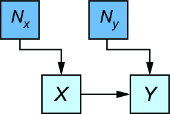
Use the causal diagram to trace enzyme quantity X into measured protein quantity Y before specifying the additive assignment. section 6.4.3
