A nonlinear additive noise model (ANM) is a structural causal model whose assignment function combines a nonlinear function of endogenous parents with additive exogenous noise: V = g(Vpa) + Nv. The noise may be Gaussian or non-Gaussian. section 6.4.6 section 6.4.3
Use ANMs when qualitative causal knowledge must become an explicit function class and noise distribution. Additivity makes model parameters more tractable to learn, and some learned parameters can have causal interpretations. section 6.4.3
A practical ANM workflow connects domain mechanisms to an SCM:
- Specify the causal variables and their parent relationships in a DAG. section 6.4.3
- Choose a nonlinear assignment function from domain knowledge, then add an exogenous noise term. section 6.4.6
- Use a dynamic model, such as an ODE, to derive the assignment function when the mechanism is naturally expressed over time. section 6.4.6
Enzyme and protein synthesis
Let X be the enzyme amount and Y the measured target-protein amount. An enzyme biologist can use an ODE describing biochemical reactions, derive its equilibrium, and choose the resulting nonlinear relationship as g(X), with additive noise representing unexplained variation. section 6.4.6 section 6.4.3
Figure 6.21 The amount of enzyme (X) is a cause the measured quantity of protein (Y).
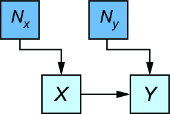
Browse the causal diagram linking enzyme amount X to measured protein amount Y. section 6.4.3
