Adversarial review challenges a consequential claim through an independent attempt to falsify it. Use it when a subtle error is expensive, a credible opposing case exists, and ordinary execution checks cannot settle the whole question. section 8.4
A writer supports the claim, a reviewer searches for consequential counterexamples, and a judge decides what the evidence warrants. An agent may judge a bounded, low-risk decision; a human maintainer is often better suited to decisions affecting production risk or policy. section 8.4
Design the review as a bounded exchange:
- Define the claim, the writer’s burden of proof, the reviewer’s search boundary, and the judge’s decision rule. section 8.4
- Give the reviewer a route to independent evidence, such as a clean context, different tools or evidence, a different model, or different acceptance criteria. Opposing role prompts alone do not establish strong independence. section 8.4
- Set a budget, stop condition, and escalation path. Revisit the changed artifact when new evidence prompts a revision; escalate consequential uncertainty that remains unresolved. section 8.10 section 8.4
Figure 8.3 Adversarial Review runs a bounded exchange around one claim. New evidence can change the artifact or verdict; an unresolved consequential claim escalates when the review budget ends.
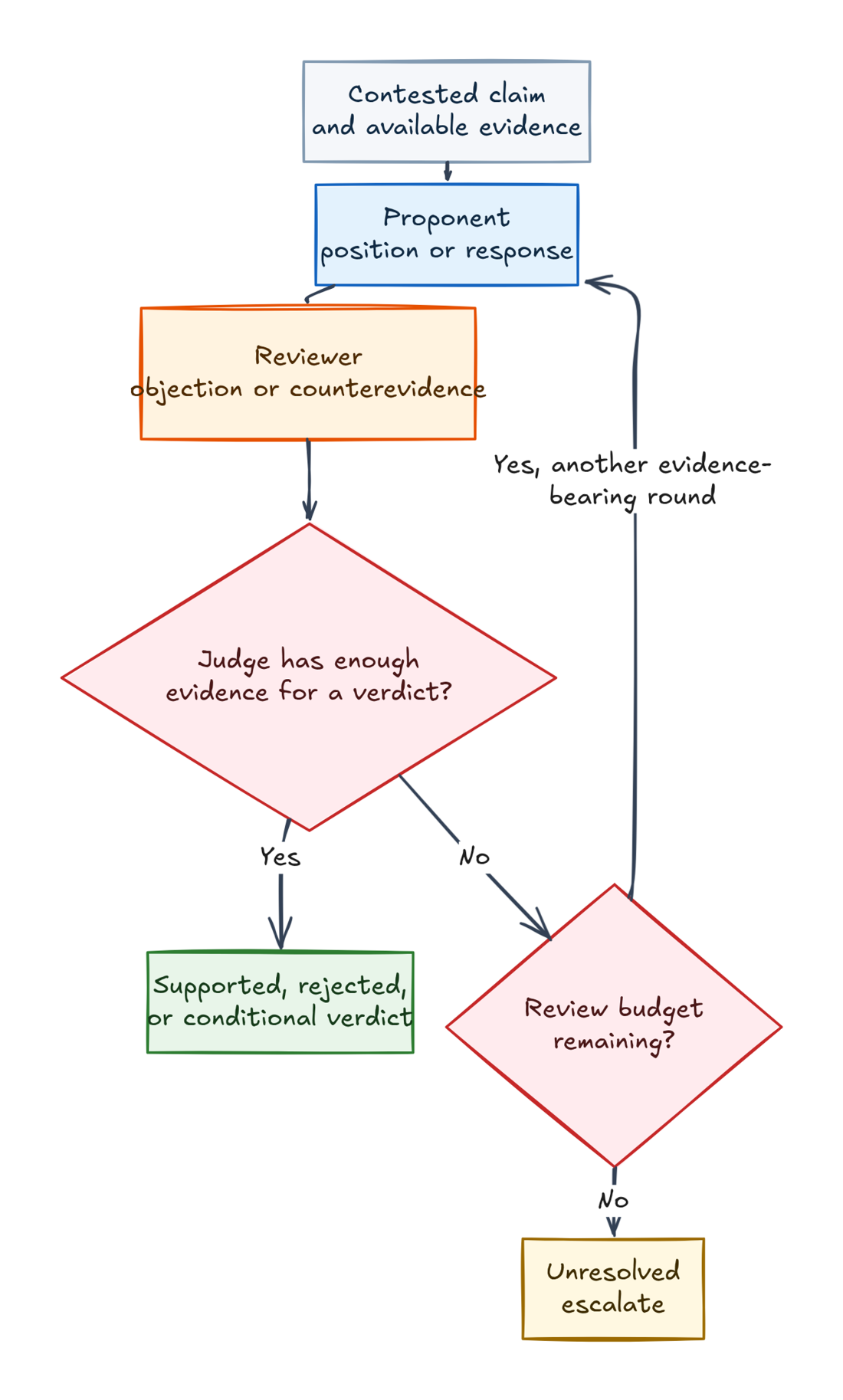
The exchange links new evidence to artifact or verdict changes and shows when an unresolved claim escalates. section 8.4
A second agent does not automatically make a review adversarial: it must be able to find something outside the writer’s frame. Generator-Critic instead revises an artifact against feedback, while an Approval Gate decides whether a proposed action may proceed. Reviewers can also converge rather than challenge each other, weakening the review. section 8.4.1 section 2.3.2
Security review of a code change
Argus distributes a code diff to security, style, and complexity workers, retaining their findings. It can then challenge a selected security claim independently. A human maintainer judges the evidence and remaining uncertainty; the review does not itself grant permission to merge. section 8.9 section 8.4
Compare the review with a credible single-agent baseline. Measure consequential defects found beyond self-review, verdict changes, unresolved disputes, and cost per useful finding; also inspect tokens, latency, failures, conflicts, and integration effort. section 8.4 section 8.10

