Thinking involves forming thoughts and reasoning, but it cannot be observed directly. We infer it from signs such as coherent expression, learning, adaptation, and problem solving. These signs matter, yet a correct or fluent response does not by itself reveal the process behind it or prove understanding. section 1.5 section 9.1.2
Language is both a means of expressing thought and a tool for organizing it. Naming helps distinguish and compare elements of experience, while syntax connects ideas and supports reasoning beyond immediate perception. This close association also makes fluent machine language tempting to treat as evidence of a mind, even though generating language does not settle whether a system thinks. section 2.1.1 section 2.1
Language and attention
Guugu Yimithirr speakers use cardinal directions rather than terms such as left and right, directing attention to orientation. Russian distinguishes light and dark blue as separate basic colors, an example of languages organizing perceptual categories differently. section 2.1.1
Figure 9.2 Intelligence inferred from observable signs. Standard definitions describe intelligence through capacities such as deriving information, learning from experience, adapting to the environment, and using reason. These capacities are recognized through performance, while the underlying mechanism remains partly hidden.
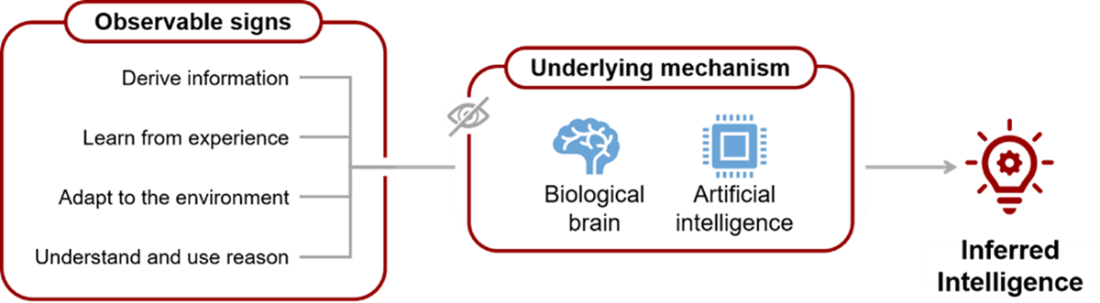
The figure distinguishes observable signs of intelligence from the partly hidden mechanisms behind them. section 9.1.2
Machine performance calls for a two-sided judgment. Hallucinations, bias, brittleness, and lack of grounding are serious limitations, but errors alone do not establish an absence of intelligence. Conversely, fluent explanations and successful problem solving do not prove human-like understanding: similar outputs can arise from different processes. section 9.0
Current AI systems show capacities associated with thought, including adaptation and problem solving, while lacking features central to human mental life, such as an embodied perspective and a continuous lived history. Their cognition may therefore be neither human thought reproduced nor empty imitation, but a form of intelligence with unfamiliar strengths and missing pieces. section 9.5.6
The boundary of thinking also shifts as machines master tasks once treated as distinctively intellectual. Arithmetic and chess became less persuasive as measures of thought when machines performed them, leaving open the question of which capacities should count and why. section 1.6.2
