Diffuse thinking is a way of stepping back from a problem rather than holding attention tightly on it. Instead of following only familiar, closely related ideas, attention broadens and seemingly unrelated connections can surface. It is useful during ideation, when immediately rejecting strange proposals can prevent promising directions from appearing. A sudden insight is not the end of the process: it becomes useful when focused thinking returns to develop and test it. section 5.2.3 section 5.2.2
Figure 5.3 Focused and diffuse thinking, represented by Barbara Oakley as a pinball racing through our neurons. The focused pinball machine has a higher chance of hitting perfectly sorted and related bumpers, while a ball in a diffuse machine bounces in all directions, hitting seemingly unrelated ideas.
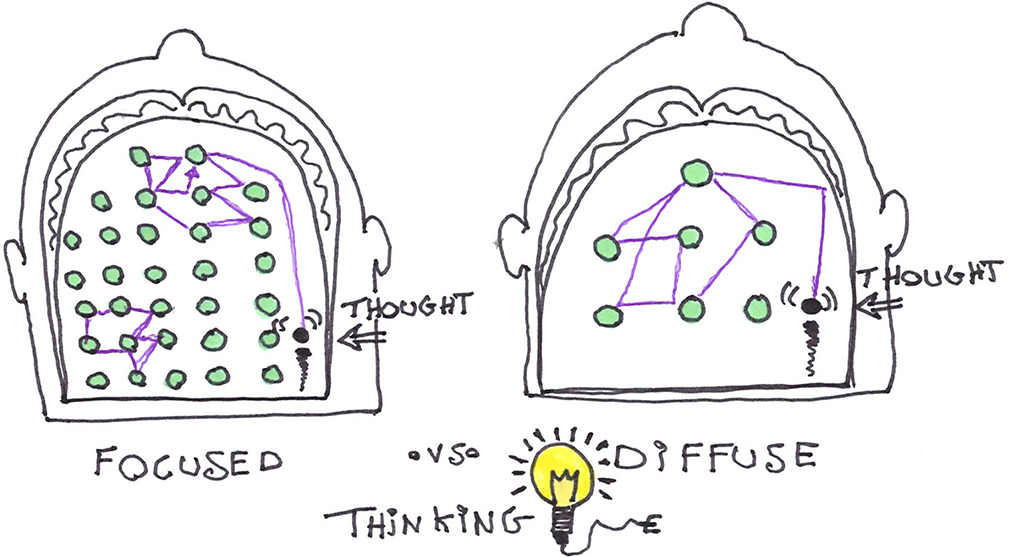
Use the pinball analogy to contrast a focused path through related ideas with diffuse bouncing among less obviously connected ones. section 5.2.3
The two modes work as a pair. Diffuse thinking generates many possibilities; focused, critical thinking evaluates them and discards weak ones. Switching matters because creativity without judgment can become impractical or fanciful, while continuous narrow focus can lose sight of the larger problem. Mind-wandering can support this broader mode, but it also has social and cognitive costs when attention must be recovered. section 5.2.4 section 5.2.3
A practical rhythm for a stubborn programming problem is:
- Zoom out when repeated focused work yields no new direction; let the problem rest rather than forcing an immediate answer. section 5.2.3 section 5.7
- Generate several possible approaches before judging them, including unusual ones. section 5.2.3 section 5.2.4
- Return to focused and critical thinking to verify which idea serves the product rather than merely looking clever. section 5.2.4 section 5.7
- Leave room for rest and a clear head; excessive stimulant-driven focus may diminish divergent ideation. section 7.4.3 section 5.2.4
Escaping an overengineered solution
Imagine a date utility growing elaborate options before anyone needs them. Rather than polishing the design further, pause and generate alternatives: remove unused flexibility, ask what client problem remains, or try a simpler representation. Then switch back to critical evaluation and keep only an approach that solves the actual need. The creative move is not adding complexity; it is producing options and verifying their value. section 5.2.4 section 5.2.2
Diffuse thinking is not a permanent state or a guarantee of insight. It belongs within a creative process that moves through participation, incubation, illumination, verification, and acceptance. When ideas run dry, changing modes may help; when an idea appears, verification keeps intuition from becoming misplaced confidence. section 5.7 section 5.2.3
