Focused thinking is deliberate, incremental problem-solving: attention narrows onto a specific issue and consciously works toward a solution. In programming, that can mean tracking a method, argument, type, exception, bracket, or constructor until the local problem yields. It turns ideas into working lines of code rather than leaving them as possibilities. section 5.2.2
Zooming in is useful for low-level problems, but it has a trap: local shortcuts can hide the wider purpose of the system. A quick choice such as adding static may seem harmless while weakening the connection between a method and the client problem. When focus becomes too narrow, step back rather than assuming more concentration will fix it. section 5.2.2
Figure 5.3 Focused and diffuse thinking, represented by Barbara Oakley as a pinball racing through our neurons. The focused pinball machine has a higher chance of hitting perfectly sorted and related bumpers, while a ball in a diffuse machine bounces in all directions, hitting seemingly unrelated ideas.
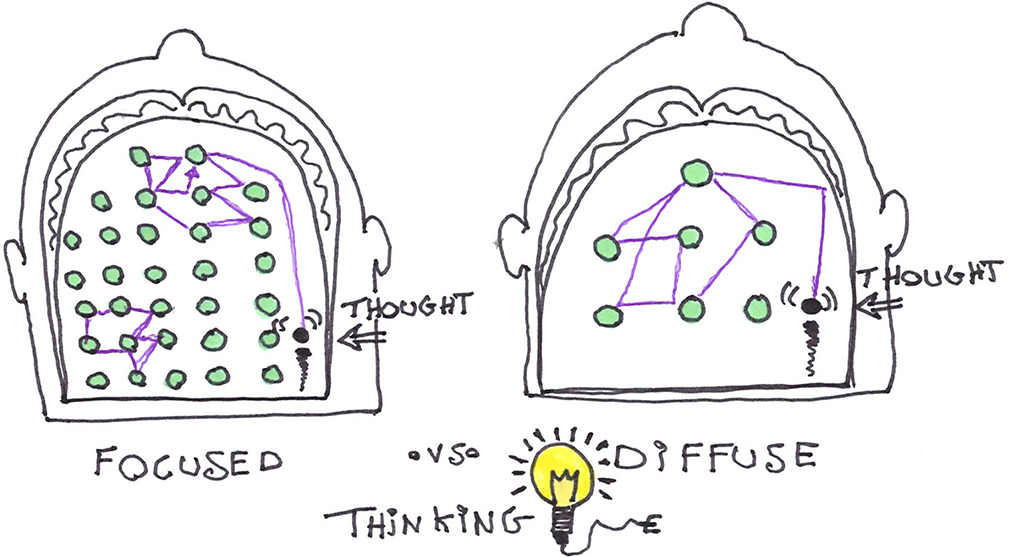
The pinball image contrasts tightly connected, relevant paths of thought with looser associations that can reach seemingly unrelated ideas. section 5.2.3
Use focused thinking as one phase of a larger creative rhythm:
- Zoom in to analyze the problem at hand and implement or test a promising direction. section 5.2.3
- Switch to diffuse thinking when you need alternatives, perspective, or fresh associations. section 5.2.3
- Return to focused and critical judgment to reject weak ideas and develop the stronger ones. section 5.2.4
- Rest and switch modes when stuck rather than treating one mental mode as sufficient for every stage. section 5.2.4 section 5.7
Avoiding creative-looking overengineering
Imagine generating several clever designs for a small date utility. Diffuse thinking can supply options; focused, critical thinking then asks which option actually serves the product. That check helps avoid speculative generality: complexity added mainly to make code feel impressive. section 5.2.4
Focused thinking is not the opposite of creativity. Creativity needs both the generation of many possibilities and the careful verification of a few. Use focus to make decisions accountable, while remembering that an idea can be imaginative yet impractical. section 5.2.4 section 5.7
