liveBook · Manning

Agentic development

As explained in Introduction to Generative AI, Second Edition

Agentic coding is software development in which AI agents plan and execute multistep programming tasks with limited human intervention.

Agentic development uses AI agents to plan and execute multistep programming tasks, moving beyond autocomplete toward collaboration with limited human intervention. section 8.6

Agents can locate bugs, update deprecated APIs, generate patches and tests, refactor functions, and pursue high-level goals across entire codebases. They may also reason diagnostically, use command-line tools, remember prior sessions, and collaborate as multiple agents. section 8.6

Two broad forms illustrate the shift:

  • Interactive IDE agents work alongside developers in real time, editing code, testing changes, and maintaining context. section 8.6
  • Autonomous background tools operate more independently for extended periods, raising practical questions about oversight and reliability. section 8.6

Delegating a feature

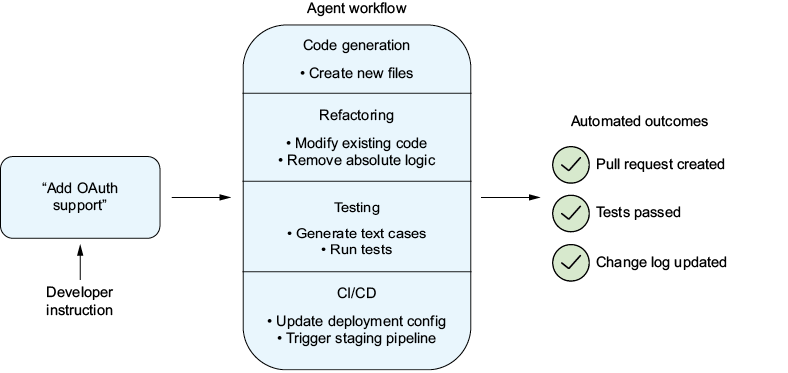
A developer can ask an agent to “add OAuth support.” The agent may chain edits across files, generate tests, run them, and iterate with minimal prompting. section 8.6

Figure 8.3 Workflow of an AI coding agent embedded in an IDE, from task planning to deployment
A diagram of a workflow

AI-generated content may be incorrect.

Follow the workflow from task planning through deployment to see how an IDE-embedded coding agent organizes delegated work. section 8.6


How Introduction to Generative AI, Second Edition covers it

How deep it goes
Explains capabilities and workflow types at a high level, stopping short of implementation details or agent internals.
Examples
Uses bug fixing, API modernization, test generation, OAuth implementation, and database migration cleanup as delegated tasks.
What you can do after
Apply agentic workflows through Copilot, Cursor, or Windsurf to delegate, test, debug, and refine multistep code changes.
How it connects
Connects agentic development with integrated development environments, software testing, debugging, refactoring, command-line integration, and multi-agent collaboration.

Also explained in

Compare how 2 books explain agentic development →

Related concepts

This explainer was generated by Manning's knowledge graph from the text of Introduction to Generative AI, Second Edition. The section links point to the parts of the book it draws on.