liveBook · Manning

Agentic lifecycle

As explained in Architecting for Autonomy

An information lifecycle in which autonomous agents create, transform, use, retain, and dispose of both source information and agent-generated artifacts.

An agentic lifecycle extends the traditional data lifecycle across source information and agent-generated artifacts. In a contract dispute, claims, agreements, amendments, emails, recordings, delivery reports, prompts, transcripts, extracted observations, summaries, and matter records move through recurring control points rather than one fixed sequence. section 5.1.1

Apply the lifecycle as a set of decision boundaries:

  • Preserve source actor, provenance, time, capture context, and evidence status for every source and derived form. section 5.1.1
  • Verify existence, accuracy, and evidential status before treating generated notes or formatted material as authority. section 5.1.1
  • Validate accuracy, completeness, format, ownership, sensitivity, and access while deciding what each artifact may support. section 5.1.1
  • Revisit capture, classification, indexing, and context when new evidence, amendments, or human review changes the matter. section 5.1.1
Figure 5.1 Agentic influence on the traditional data lifecycle stages
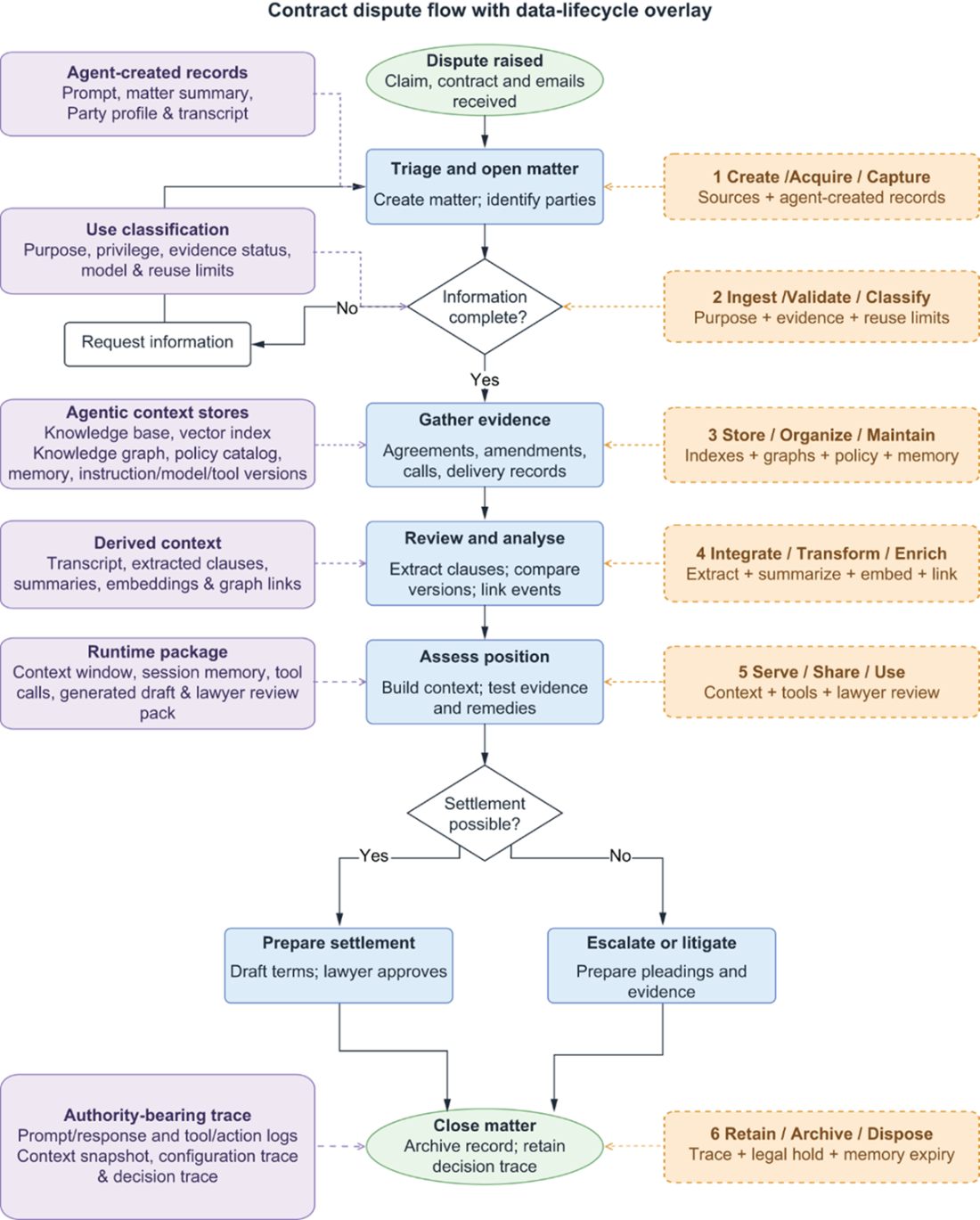
Use the lifecycle figure to trace how agentic activities recur across the contract-dispute flow. section 5.1.1

How Architecting for Autonomy covers it

How deep it goes
Distinguishes capture, provenance, validation, classification, and evidential status, but stops short of a complete lifecycle implementation.
Examples
Uses a contract dispute involving claims, agreements, recordings, transcripts, summaries, amendments, and lawyer review.
What it assumes
Assumes familiarity with the traditional data lifecycle and teaches how agents widen capture and classification decisions.
What you can do after
Evaluate whether information and agent artifacts are verified, appropriately classified, and safe for intended use.
How it connects
Connects data lifecycle, provenance, evidence, classification, access control, indexing, and persistent memory.

Related concepts

This explainer was generated by Manning's knowledge graph from the text of Architecting for Autonomy. The section links point to the parts of the book it draws on.