liveBook · Manning

Business abstract layer

As explained in Applied Reinforcement Learning

The business abstract layer is a problem-framing layer that identifies, scopes, and describes the operational problem and its relevant entities, assumptions, and metrics.

The business abstract layer turns a broad optimization goal into a bounded, solvable process. Scope one part of the operation rather than trying to optimize an entire enterprise at once; identify its relevant entities and make assumptions explicit. section 3.1

Last-mile delivery

Rather than optimize routing, shifts, trailers, traffic, and loading together, start with each driver’s route in a given time window, holding other factors fixed or given. Relevant entities might include vehicles, customers, depots, traffic zones, and delivery time windows. section 3.1

Figure 3.1 Conceptual framework for designing business optimization environments
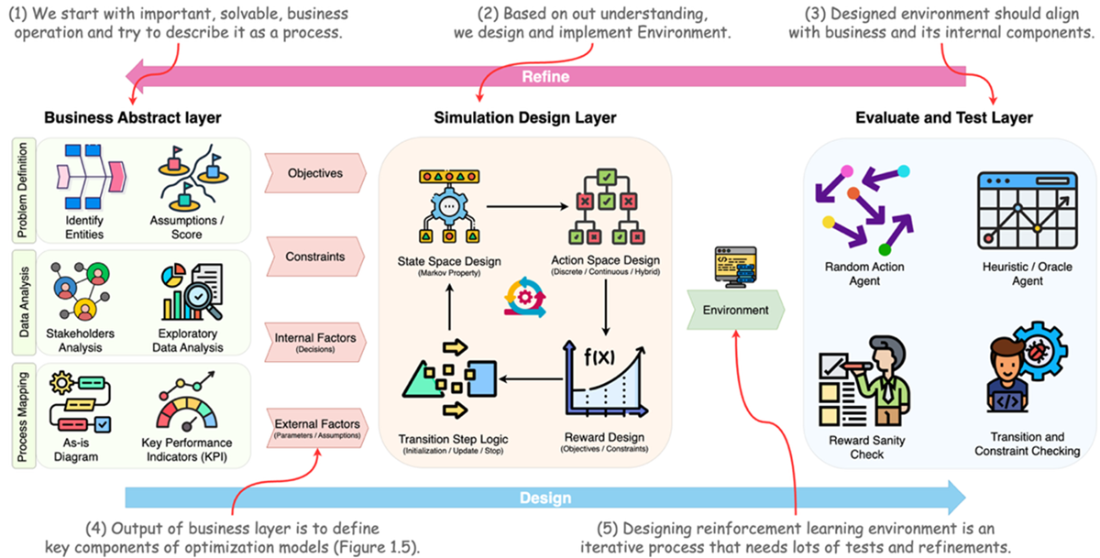
Use the framework figure to see where business problem framing sits in the environment-design process. section 3.1

How Applied Reinforcement Learning covers it

How deep it goes
Explains scoping, modularity, entities, and assumptions, stopping at the initial problem-framing step.
Examples
Uses last-mile delivery routing and names vehicles, customers, depots, traffic zones, and delivery time windows.
What you can do after
Apply it to define a manageable operational problem and identify its entities and assumptions.
How it connects
Connects business optimization with reinforcement learning and custom environments.

Related concepts

This explainer was generated by Manning's knowledge graph from the text of Applied Reinforcement Learning. The section links point to the parts of the book it draws on.