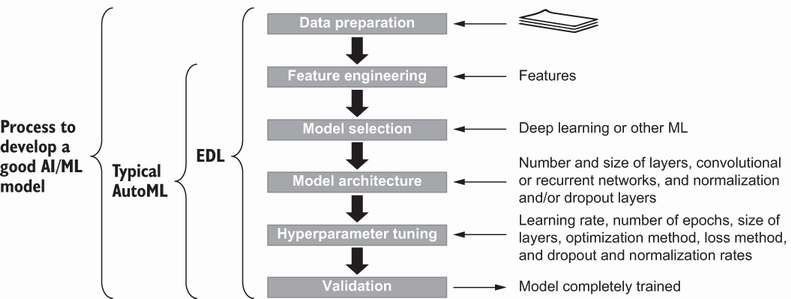
The sequence of data, modeling, configuration, training, tuning, evaluation, and deployment activities involved in building an AI or machine-learning model.
An AI/ML model development workflow organizes the activities required to build a model for confident inference on new data. It can be performed manually or supported throughout by automated machine-learning methods. AutoML is a collection of tools and strategies rather than a single technology; evolutionary algorithms and evolutionary optimization form one subset. section 1.4.1
The workflow includes:
Preparing and cleaning training data, a time-consuming activity that can strongly affect data-workflow performance. section 1.4.1
Applying automation across model-building activities, including model development, tuning, and network-architecture search. section 1.4.1
Figure 1.3 Steps for developing a good AI/ML model with AutoML and/or EDL
Use the workflow figure to inspect the stages involved in developing a model with AutoML or evolutionary deep learning. section 1.4.1
How Evolutionary Deep Learning: Genetic algorithms and neural networks covers it
How deep it goes
Maps workflow automation and data preparation, while deferring detailed evolutionary preparation methods.
Examples
Names DataRobot, Google Cloud AutoML, Amazon SageMaker Autopilot, H2O AutoML, Azure Machine Learning, AutoKeras, and AutoTorch.
What it assumes
Assumes prepared and cleaned data for many online AutoML services before automated model development begins.
What you can do after
Operate AutoML platforms to automate parts of model development, tuning, data handling, or architecture search.
How it connects
Connects data preparation, automated machine learning, evolutionary algorithms, model tuning, and network-architecture search.
workflowkind of · A workflow is an organized sequence of coordinated activities, tasks, or decisions through which work progresses toward an outcome.
offline evaluationhas part · Offline evaluation is the assessment of a system using prepared or previously collected data outside live interactions or production traffic.
hyperparameter tuninghas part · Hyperparameter tuning is the process of selecting or adjusting configurable model or procedure settings and evaluating them against a chosen objective.
feature engineeringhas part · Feature engineering is the creation, transformation, or selection of input features from data to provide useful representations for analysis or modeling.
validation selectionhas part · The process of selecting and applying procedures for evaluating model performance on training and testing data.
This explainer was generated by Manning's knowledge graph from the text of Evolutionary Deep Learning: Genetic algorithms and neural networks. The section links point to the parts of the book it draws on.