Aleatoric uncertainty is irreducible uncertainty caused by inherent randomness or noise in the data-generating process. A noisy measurement can remain unpredictable even when the model has learned the underlying pattern perfectly. section 10.1
Consider observations generated from a sine function and then corrupted by noise. A standard neural network can fit the pattern, but a single-valued prediction does not show how much variation belongs to the observations themselves. This differs from epistemic uncertainty, which comes from limited knowledge or sparse data. section 10.1
Aleatoric uncertainty matters because:
- It remains even with abundant knowledge when the data-generating process contains irreducible noise. section 10.1
- It should appear in predictive uncertainty rather than being hidden behind one confident number. section 10.1
- It must be distinguished from uncertainty caused by sparse data, which is epistemic and potentially reducible. section 10.1
Noisy observations versus unfamiliar regions
A neural network may predict the observed sine-shaped data well while failing to display the noise around those observations. Outside the training range, its confident single prediction reflects missing uncertainty about the function, not aleatoric noise alone. section 10.1
Figure 10.1 A sample training set where data are generated from the sine function and corrupted by noise.
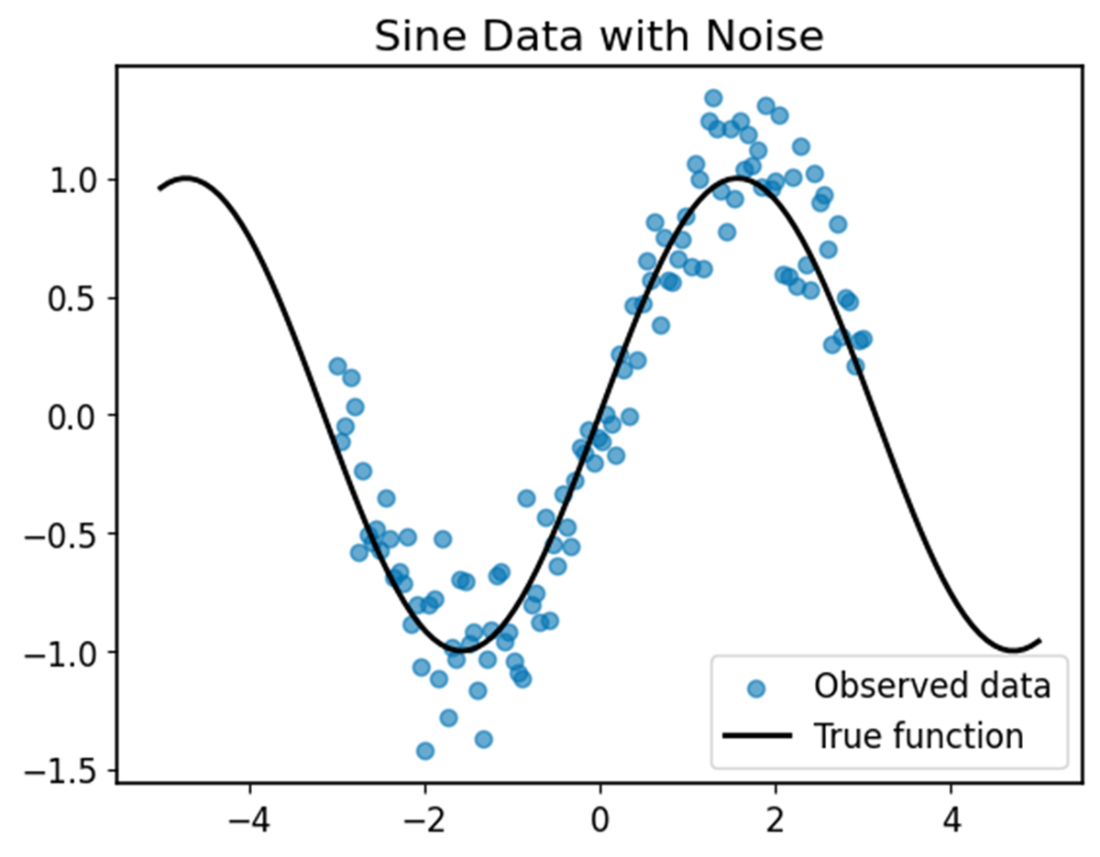
Inspect the noisy sine-function training set to see how aleatoric uncertainty appears as variation around an underlying pattern. section 10.1
Figure 10.3 Predictions made by a standard neural network, which don’t include uncertainty quantification despite its importance in indicating both observation noise and data sparsity.
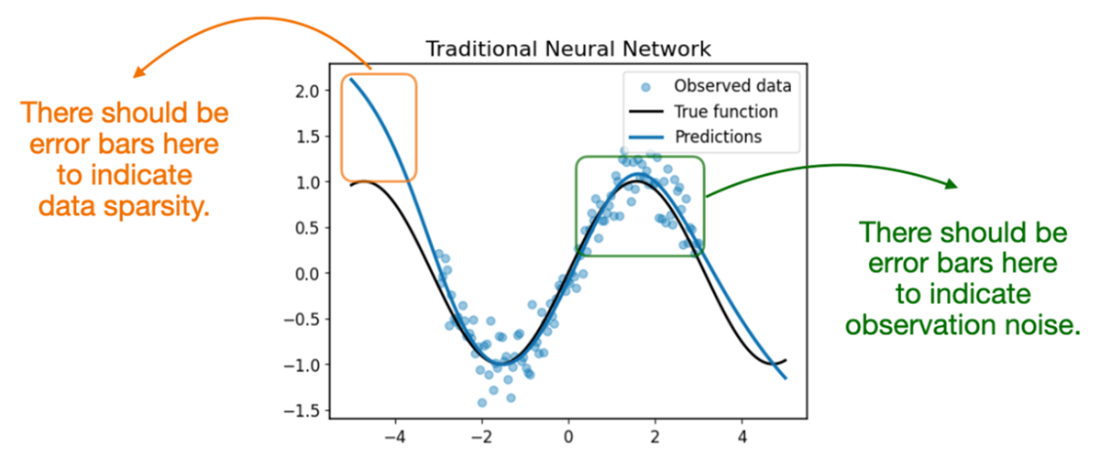
Compare single-valued neural-network predictions with the missing uncertainty caused by observation noise and sparse data. section 10.1

