Aleatoric uncertainty is uncertainty inherent in the data-generating process. It can arise from overlapping classes, additive noise, or other complexity in the observations, and additional training data does not remove it. section 6.4
This distinction matters before committing to an ML project. More data may improve a model when uncertainty comes from limited knowledge, but it cannot make an intrinsically random or ill-posed task predictable. section 2.0 section 6.4
Use the distinction as a practical data and problem-definition checklist:
- Ask whether errors reflect missing coverage in the training data or irreducible ambiguity and noise in the data itself. section 6.4
- Treat additional data as a limited remedy when uncertainty comes from overlapping classes or additive noise. section 6.4
- Reject problems whose desired performance contradicts the randomness of the process rather than trying to optimize the model indefinitely. section 2.0
Roulette and ambiguous classes
Casino roulette illustrates an irreducible limit: no algorithm can reliably beat the randomness of the game. In classification, overlapping classes or noisy observations create a less dramatic but similar ceiling that more training examples cannot eliminate. section 2.0 section 6.4
Figure 6.4 A schematic view of the main differences between aleatoric and epistemic uncertainties (source: “Explainable Uncertainty Quantifications for Deep Learning-Based Molecular Property Prediction” by ChuI Yang and YiPei Li, https://mng.bz/n0ZV)
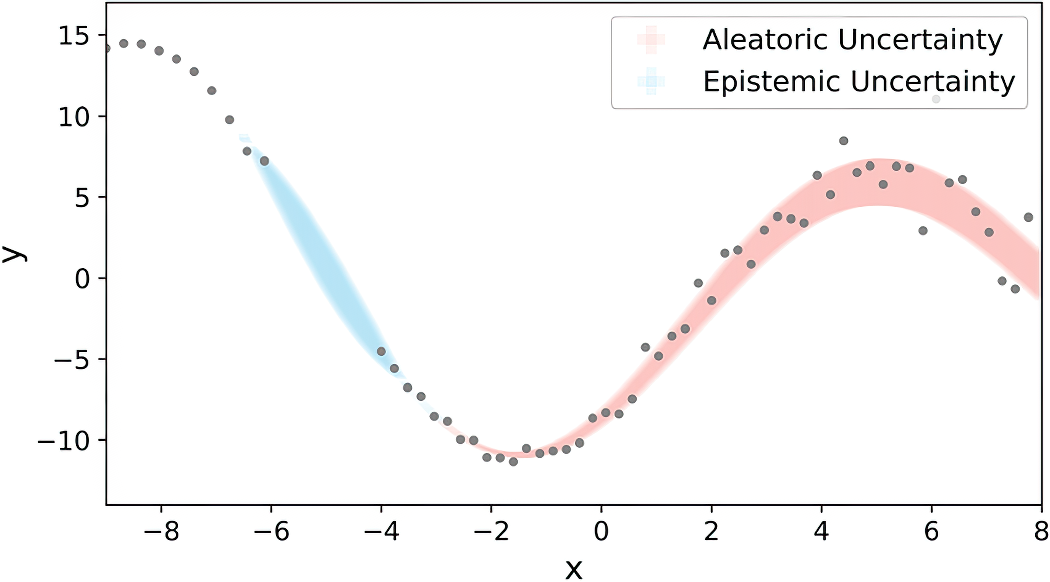
Use the schematic comparison to distinguish aleatoric uncertainty, which is present in the data, from epistemic uncertainty, which reflects sparse or uncovered input regions. section 6.4
