Epistemic uncertainty comes from limited knowledge: a model encounters an input in a region thinly covered by training data or outside its scope. Unlike aleatoric uncertainty, it can decrease when relevant training data is added. section 6.4
Use the distinction when deciding whether more data could improve a model:
- Treat sparse or out-of-scope inputs as signs of epistemic uncertainty. section 6.4
- Do not expect additional training data to remove aleatoric uncertainty caused by overlapping classes or additive noise. section 6.4
- After establishing a training pipeline, estimate whether collecting more data is economically worthwhile, especially when labeling is expensive. section 6.4
Figure 6.4 A schematic view of the main differences between aleatoric and epistemic uncertainties (source: “Explainable Uncertainty Quantifications for Deep Learning-Based Molecular Property Prediction” by ChuI Yang and YiPei Li, https://mng.bz/n0ZV)
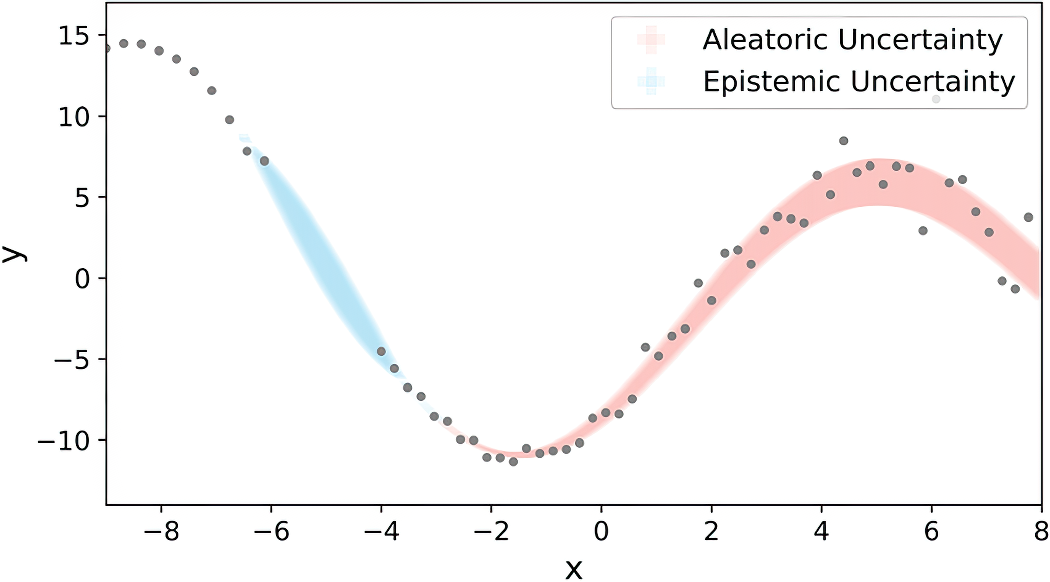
Compare how limited training-data coverage differs from uncertainty inherent in the data itself. section 6.4
