A social media feed might repeatedly show someone posts similar to one they clicked. As those posts reach more people, recommendations can shape what users see and what creators choose to share. Algorithmic amplification is the additional exposure content receives through automated selection and distribution. section 1.0 section 4.8
Amplification happens through both selecting content and ranking it. A post placed consistently near the top of a feed may receive more exposure than others; a recommendation can also introduce it to people who do not follow its creator. Platform goals and user behavior both influence these systems. section 1.3.4 section 1.4 section 5.6
Figure 1.1 The feedback loop between user and recommender systems. Users and recommender systems are in a mutual feedback loop, with the output of one serving as the input to the other. The output of the algorithm, the recommendations, is the input for the users. The users’ output, what they engage with, is a signal for the recommender. On top of that, both the user and the recommender system update their internal state. Users change their minds and evolve their preferences over time, while algorithms learn users’ preferences and try to align more with them.
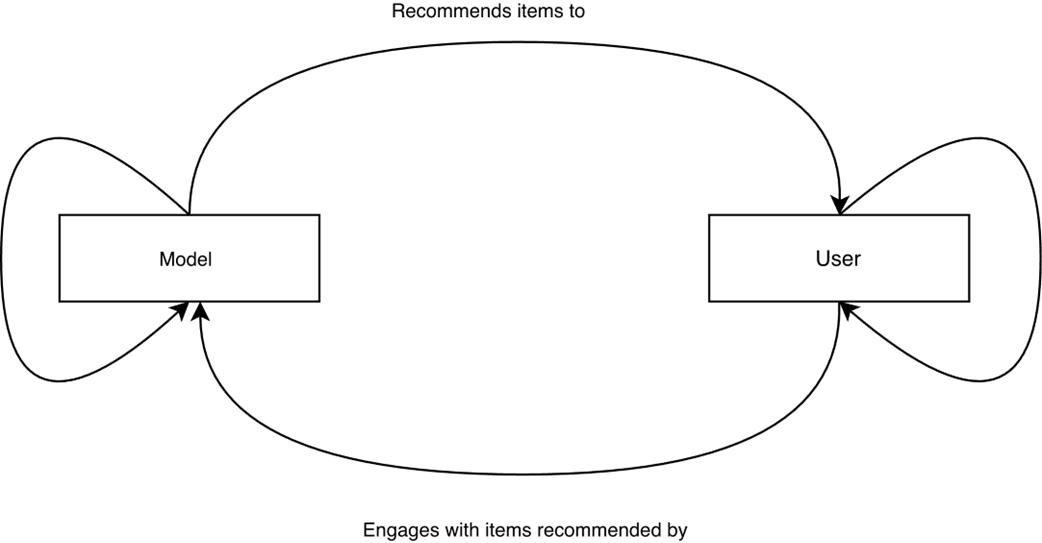
The feedback loop shows how recommendations influence engagement, while engagement helps shape later recommendations. section 1.0
This feedback makes responsibility and measurement difficult to separate: users choose what to engage with, but their choices are made among content the system has already shown them. Preferences can change over time, and past recommendations affect the signals used to infer them. section 1.0 section 4.8
Measuring amplification requires a comparison, but no single measure captures the whole picture:
- Choose a baseline. Reverse chronological order is often used, though no universal neutral baseline exists for personalized systems. section 4.8
- Compare systems. An A/B test can compare a new recommender with an older one using exposure to particular content. section 5.5.2
- Consider different perspectives. Producer-side measures can compare impressions with follower counts or examine exposure outside a creator’s network. Reader-side measures can ask whether a feed reflects the distribution of possible content. section 5.5.2 section 5.6
Comparing exposure
Suppose content receives twice as many impressions on average under a new recommender as under the old one. Its exposure ratio is 2 relative to that baseline. A ratio of one-third would mean it receives only one-third as much exposure under the new system. The result describes that content, not amplification in general. section 5.5.2
Measuring exposure is a starting point, not a complete account of quality or harm. Like a nutrition label, an amplification report can inform choices without describing the whole experience. Different measures reveal different aspects, and choosing them is a question of power; affected stakeholders, especially historically marginalized communities, should have a voice. section 1.3.4 section 5.1 section 5.6
The consequences depend on what is promoted and the surrounding social context. Recommendations can expand the reach of movements for change, but also of harassment and conspiracy theories. Measuring amplification can help identify unusual deviations from a baseline, including possible manipulation, without by itself proving a particular societal effect. section 7.6 section 5.6 section 1.3.4
