Alpha measures return not explained by market exposure. In a regression of an investment’s excess return on the market’s excess return, alpha is the intercept: r − rf = α + β(rm − rf) + ε. A positive alpha suggests the investment outperformed its benchmark after accounting for beta. section 7.2.2
Figure 7.3 Scatter plot of returns of an investment against returns on the market
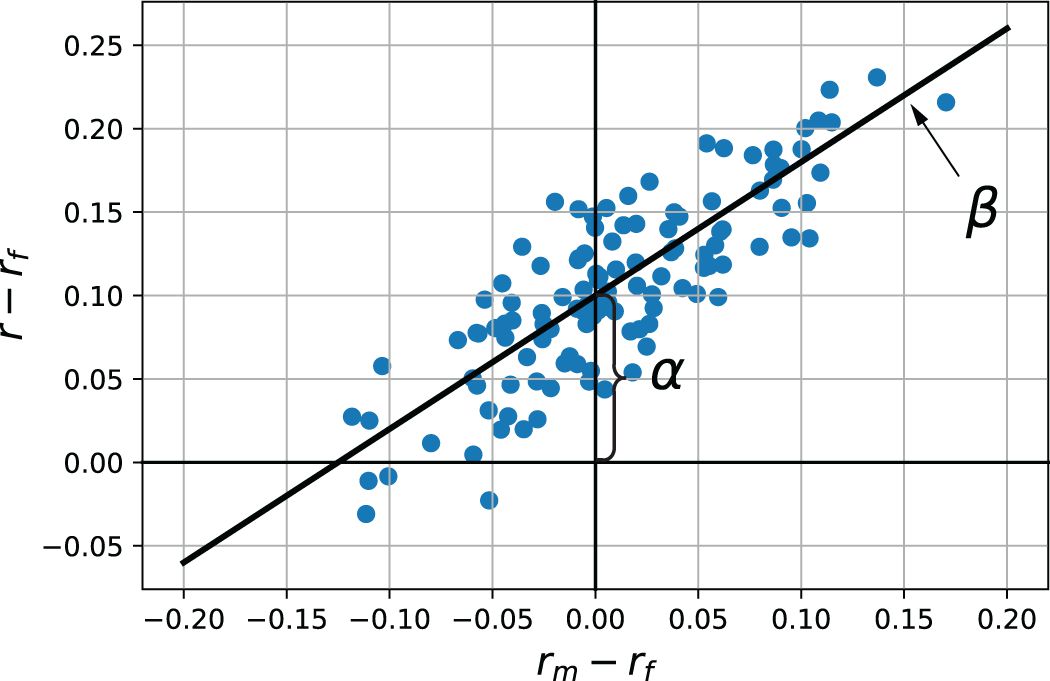
Plotting investment excess returns against market excess returns makes beta the fitted line’s slope and alpha its intercept. section 7.2.2
The single-factor form separates expected excess return into alpha plus a market risk premium scaled by beta. It can be extended with multifactor models, including the three-factor Fama–French model, when market exposure alone may not explain returns. section 7.2.2 section 3.1.2
Use alpha with its risk scope in mind:
- Alpha accounts for market risk but ignores idiosyncratic risk, the unique risk that can be diversified away. section 7.2.4 section 7.3
- Prefer alpha when evaluating an investment held as one part of a diversified portfolio. section 7.2.4
- Prefer the Sharpe ratio when the investment is the entire portfolio, because it includes both market and idiosyncratic risk. section 7.2.4 section 7.3
CAPM expectation versus realized performance
CAPM implies zero alpha for a fund or portfolio: expected return is attributed to risk-free return and market beta. Persistent deviations from that prediction motivate debate over mispricing, behavioral effects, and additional return factors. section 3.1.2 section 7.2.2
