Risk-adjusted return evaluates investment performance relative to the risk required to achieve it. Comparing returns alone can mislead when leverage or differing volatility magnifies results. section 7.2
Use the measure that matches the investor’s risk perspective:
- Sharpe ratio: (expected return − risk-free rate) / volatility. It measures expected reward per unit of total risk and corresponds to the slope of the capital allocation line. section 7.2.1
- Alpha: excess return after accounting for market exposure. It captures market risk but ignores idiosyncratic risk that can be diversified away. section 7.2.4 section 7.3
- Information ratio: a benchmark-relative counterpart in which return and volatility are measured against a benchmark. section 7.3
A leverage-invariant Sharpe ratio
An investment expected to return 20% with 15% volatility and a 5% risk-free rate has a Sharpe ratio of (20% − 5%) / 15% = 1.0. Doubling the investment through borrowing doubles expected return and volatility, while borrowing costs preserve the same ratio. section 7.2.1
Choose alpha when evaluating one asset within a diversified portfolio; choose the Sharpe ratio when the investment represents the investor’s entire portfolio. High risk-adjusted return can still produce too little absolute return for financial goals. section 7.2.4 section 11.3
Figure 7.6 Two investments with the same alpha but different idiosyncratic risk
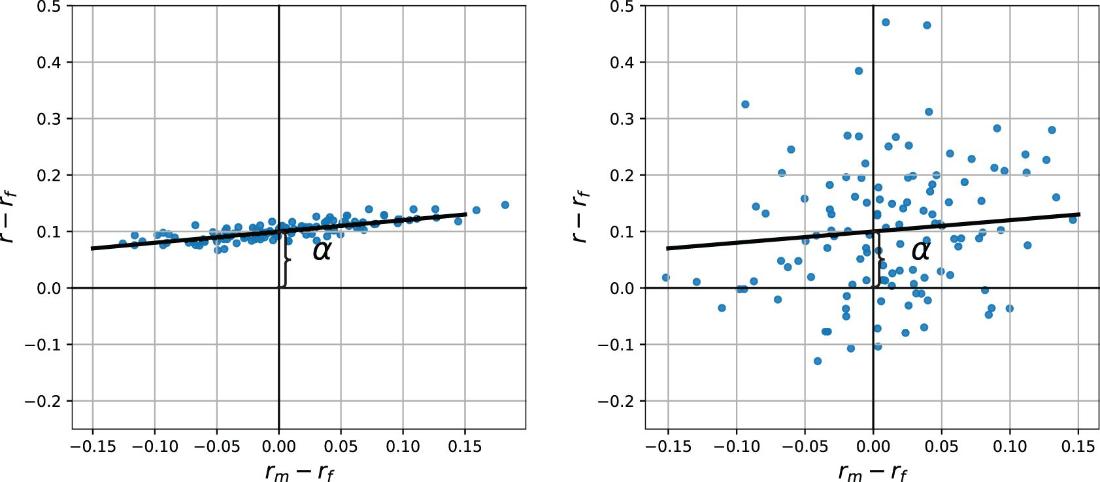
Compare investments with equal alpha but different idiosyncratic risk to see why alpha and Sharpe ratio can rank them differently. section 7.2.4
