A lender making fast financing decisions may need a fresher view of a business than traditional variables provide. Alternative data is information from nontraditional sources used to assess businesses, markets, or economic conditions. In quantitative trading, it is a third broad data category alongside market and fundamental data; each can offer predictive signals but brings structural challenges and potential bias. section 10.2.1 section 1.3.1
Point-of-sale sales data in underwriting
Toast uses real-time sales data from restaurant merchants’ point-of-sale systems in an AI-driven underwriting model to make near-instant financing decisions. The operational data gives the model a more current view of merchant activity than a limited, slowly updated set of traditional variables. section 1.3.1
Figure 10.2 The professional quant’s framework for evaluating data sources is a five-point due diligence process to systematically filter potential alpha streams. In a world of infinite data, the ability to make intelligent choices is paramount. This framework isn’t merely a checklist but a rigorous gating process that professional funds use to assess the viability of any potential data source before committing significant time and resources.
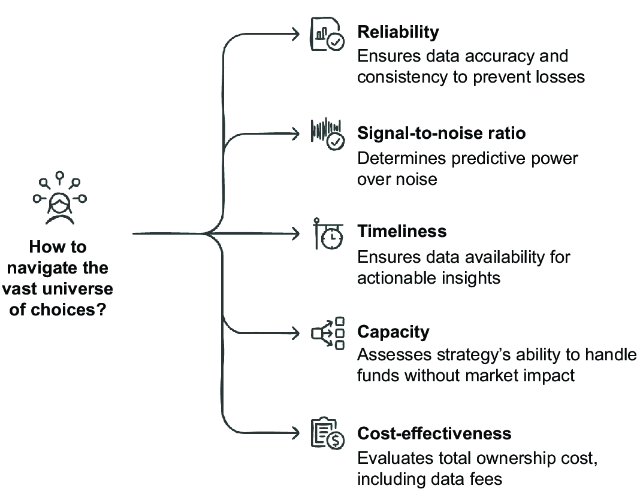
Use the five-point data-source due-diligence framework as a gate before investing heavily in a potential predictive signal. Alternative data should be assessed for viability, not accepted simply because it is new or abundant. section 10.2.1
