Amdahl’s law estimates the theoretical speedup available when parallelizing a fixed-size computation. It relates the parallelizable fraction of execution to the number of execution units, while exposing the limit imposed by sequential work. section 2.1.2
Use it before optimizing latency: identify the fraction that can run in parallel, estimate the effect of additional CPU cores or other execution units, then measure the real system. The model establishes bounds rather than replacing measurement. section 2.1 section 2.7
Order-processing endpoint
An endpoint spends 5 ms parsing and validating a request, 15 ms performing database lookups, and 30 ms calculating and inserting the order. The sequential total is 50 ms. Only the 15 ms lookup stage is parallelizable, so P = 0.3; using two CPU cores produces a modest 1.2× speedup. The dependent stages remain sequential. section 2.1.2
Figure 2.4 Amdahl’s law illustrated. The graph shows theoretical speedup (y axis) as a function of parallelism (x axis) given how much of the program is parallelizable.
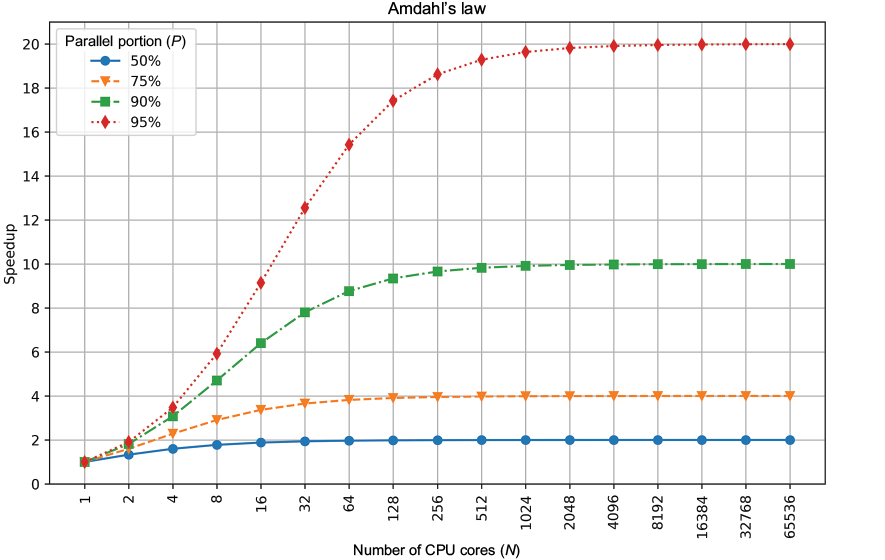
Compare theoretical speedup as parallelism increases for different parallelizable fractions; the curves show diminishing returns and the cost of sequential work. section 2.1.2
Parallelism helps most when the parallelizable fraction is large: 50% parallelizable work reaches only 2× maximum speedup, whereas 95% can benefit across roughly 200 cores before diminishing returns dominate. section 2.1.2


