Amdahl’s law states that optimizing or parallelizing one part of a system cannot overcome the time spent in sequential work. The non-parallel portion becomes the bottleneck limiting overall speedup. section 1.6.1
Building a house with more workers
A house project may be 95% parallelizable, while tasks such as moving materials along a single road remain sequential. Even with 512 builders, the project finishes only about 19 times faster; adding more workers eventually wastes money. section 1.6.1
Use Amdahl’s law to reason about scalability:
- Find the work that must happen one step at a time. section 1.6.1
- Estimate whether additional processors can improve the parallel portion enough to matter. section 1.6.1
- Avoid assuming that more workers or processors will produce proportional gains. section 1.6.1
Amdahl’s law describes fixed-size problems. Gustafson’s law offers a complementary view: increasing the problem size can keep additional resources busy when the serial portion stays relatively constant. section 1.6.2 section 1.7
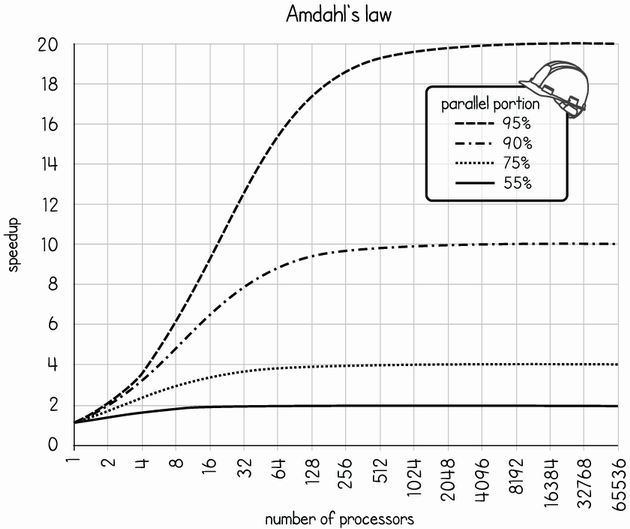
Shows how theoretical speedup changes as processor count increases for different parallel-to-sequential ratios. section 1.6.1


