A music app prominently displays popular songs, making them easier to choose and potentially more popular still. This is amplification: an increase in the visibility, reach, or influence of content through how it is distributed and presented. section 1.3.3 section 4.1
Recommendations amplify some content because attention is limited. Autoplay and infinite feeds can make recommendations especially influential: the platform queues what a person encounters next, often without an explicit choice. What people see, and how others react to it, can shape opinions and perceptions of what matters. section 1.3.2
Amplification is not determined by one recommender alone. Feed design, search results, profile suggestions, notifications, and trending pages all affect what people encounter. Presentation can also affect how they perceive and react to content. section 2.6
Figure 5.1 When a user U produces some content C, that content can be delivered to others in two different ways. First, it will be added to the pool of in-network content for users who follow U directly. At the same time, it might be algorithmically flagged as content with high relevance (or high probability of engagement) for users who don’t follow U directly. In that case, it will be inserted in the out-of-network bucket and be ranked accordingly. In neither case is there a guarantee that other users will see C, as it will compete for a spot with all the other content.
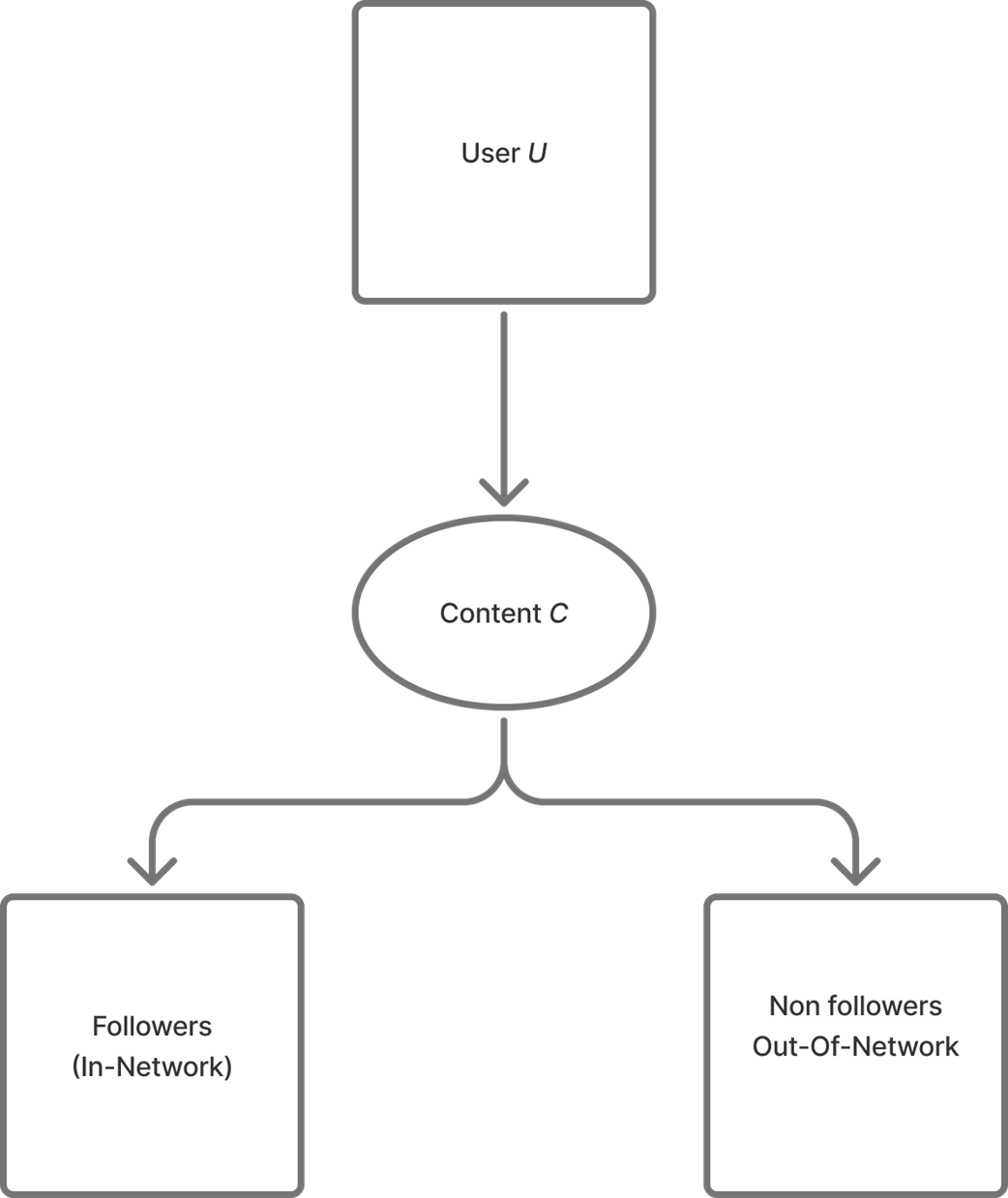
A post can enter the candidate pool for followers and for people who do not follow its creator. In either pool, it must compete for a place in the feed; inclusion does not guarantee it will be seen. section 5.4
A lopsided news feed
Someone follows a left-leaning and a right-leaning news outlet, but one accounts for 80% of the content they see. That imbalance might indicate extra amplification, but it is not conclusive: the person’s interactions and the amount each outlet publishes also matter. section 5.5.3
Measuring amplification requires a unit and a baseline for comparison. One perspective asks how much exposure a creator receives; another examines what appears in a reader’s feed. No single metric necessarily captures the whole picture, and too many metrics can make decisions harder. section 4.1 section 5.5.3 section 5.3
The stakes are social as well as technical. Extra exposure can bring niche or harmful views into the mainstream, but user preferences and interactions complicate judgments about cause. Choosing what to measure is also a question of power: independent scrutiny can help check platform accounts of their impact. section 5.2 section 5.3 section 1.3.3
