liveBook · Manning

Amplitude

As explained in Acing the CCNA Exam: Volume 2 Advanced Networking and Security

Amplitude is the maximum magnitude of a wave's oscillating field or displacement from its equilibrium value.

Amplitude is the maximum strength of a wave’s electric and magnetic fields. In wireless LANs, greater amplitude means a stronger signal carrying more energy. section 18.2 section 18.2.1

Use these distinctions when interpreting wireless signals:

  • A signal with insufficient amplitude may be too weak for a receiver to distinguish a coherent message. section 18.2.1
  • Amplitude describes field strength; frequency describes how quickly the electric and magnetic fields oscillate. section 18.2.1
Figure 18.5 Waves with higher amplitude carry stronger signals, indicated by greater electric and magnetic field strengths.
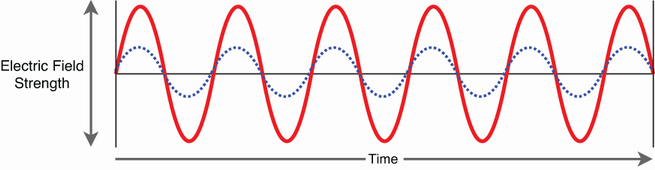
Compare waves visually: the higher-amplitude wave has greater electric and magnetic field strength and represents the stronger signal. section 18.2.1


How Acing the CCNA Exam: Volume 2 Advanced Networking and Security covers it

How deep it goes
Defines amplitude, relates it to energy and signal strength, and contrasts it with frequency without developing mathematical formulas.
Examples
Uses paired waves with different amplitudes to show that greater field strength represents a stronger signal.
What you can do after
Evaluate wireless wave diagrams and identify whether amplitude indicates a stronger or weaker signal.
How it connects
Connects amplitude with electromagnetic waves, electric and magnetic fields, frequency, energy, and signal attenuation.

Also explained in

Compare how 2 books explain amplitude →

Related concepts

This explainer was generated by Manning's knowledge graph from the text of Acing the CCNA Exam: Volume 2 Advanced Networking and Security. The section links point to the parts of the book it draws on.