Anchoring bias occurs when the first number or idea considered shapes a later estimate, even when that starting point is unrelated to the decision. In demand forecasting, this can turn an early opinion into an implicit target rather than an evidence-based view of future demand. Awareness matters because cognitive biases can reliably weaken forecasts despite good intentions. section 16.2.1 section 16.4
The first number in the meeting
A colleague opens a forecast meeting with: “I believe we will sell 20% more than last quarter.” That figure can anchor the group’s discussion before participants have independently reviewed demand signals. The effect need not depend on relevance: an experiment described participants whose estimates of African countries in the UN shifted with a number produced by a wheel of fortune. section 16.2.1
Anchors are especially costly when judgment is used to enrich a model-generated forecast. External information, a manager’s email, a colleague’s remark, or an early verbal estimate can alter judgment and pull the final forecast away from an unconstrained estimate of future demand. Anchoring can also combine with groupthink, as people favor harmony and hesitate to offer a divergent forecast. section 16.4 section 16.3.1
Reduce anchoring in collaborative forecasting by designing the process around independent judgment:
- Ask each participant to prepare a forecast and supporting assumptions alone before forecasts are shared. section 16.3.1
- Protect contributors from social, hierarchical, political, and peer pressure so differing predictions can be voiced safely. section 16.3.1
- Use anonymous predictions when direct discussion creates excessive influence or pressure. section 16.3.1
- Bring together people with varied backgrounds and mindsets, while aligning objectives so forecasts are not distorted into sales targets or supply plans. section 16.4
- Discuss assumptions rather than letting an unexamined opening number set the direction of debate. section 16.4
Figure 16.6 Groupthink illustrated by Jono Hey on his website sketchplanations.com
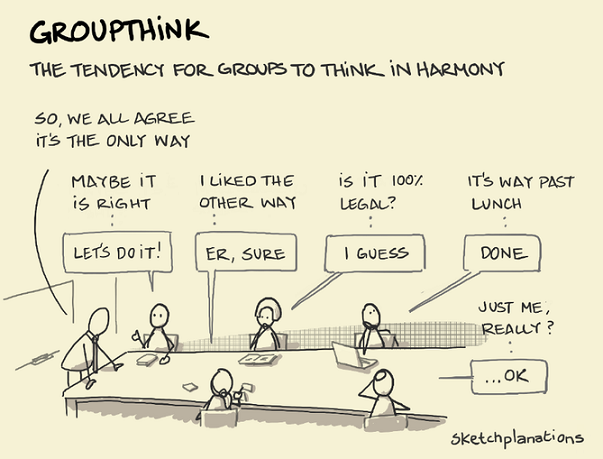
Use the groupthink illustration to inspect how pressure for consensus can amplify an anchor: a shared early view may crowd out independent forecasts. section 16.3.1
The aim is not to remove judgment from forecasting. Judgment can add field knowledge and other information unavailable to models. The operational discipline is to collect those judgments independently first, then compare forecasts and assumptions, so the team gains diverse insights rather than merely converging on the first stated number. section 16.4 section 16.3.1

