Annotation quality control checks whether labels are reliable enough for their intended use. The right check depends on the task: a single item may have multiple valid interpretations, and some errors are easier for a person to review than to detect automatically. section 9.1 section 10.2
For subjective tasks, disagreement is not always an error. An image of a person pushing a bicycle might reasonably be labeled “Pedestrian” or “Cyclist.” Quality control should preserve valid minority interpretations while excluding invalid ones. Open-ended tasks make defining correct answers harder, increasing the importance of expert review. section 9.1 section 9.0
Choose checks that fit the annotation workflow:
- Communicate goals and guidelines clearly, and consider whether annotators have the cultural and demographic knowledge needed for the task. These choices matter especially when judgments lack solid ground truth. section 9.1
- For bounding boxes, add an accept-or-reject review step. Checking a box can be much faster than drawing one, but a binary decision does not measure the size of an error. Compare boxes with ground truth or examine annotator agreement when more information is needed. section 10.2
- For sequence labeling, ask annotators to review candidate spans when available; binary or categorical review is easier to check than raw span annotation. Also annotate some raw data, since showing only model-generated candidates risks perpetuating model bias. section 10.4
Figure 10.6 A review task in which an annotator is evaluating whether a bounding box (typically created by a different annotator) is correct or incorrect. Review tasks form the backbone of many quality control strategies when programmatic quality control is difficult or will take more resources.
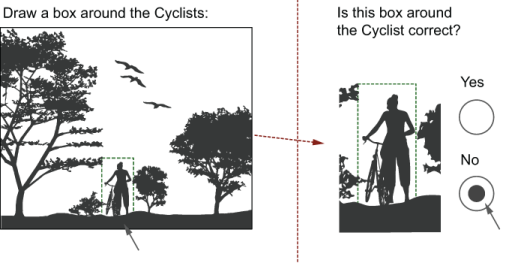
A bounding-box review task separates the work of drawing a box from the quicker decision of accepting or rejecting it. section 10.2
A binary classifier can predict whether an individual annotation is correct using limited ground truth. This is useful when most items have only one annotation, so agreement is unavailable. A simple model can use annotator identity and the assigned label; agreement, item or annotator metadata, and embeddings can add context. Metadata may reveal patterns such as images taken at night being harder to label accurately. section 9.2.3
Reviewing location spans
For an outbreak report, annotators might review candidate location names such as “San Francisco.” Reviewing proposed spans simplifies the quality-control task, but it should not replace all annotation of raw reports: the candidate model may miss relevant spans. section 10.4