Marketing teams need useful customer insights without exposing the people behind them. Anonymization removes or irreversibly alters personally identifiable information so that re-identification is virtually impossible. Used alongside data minimization—keeping only data essential to a business objective—it reduces privacy risk while preserving room for analysis. section 2.3.3
The level of detail retained determines what an organization can learn:
- Anonymization removes identifying detail. A retailer can report visitor counts or average dwell time by location without retaining exact timestamps or precise locations, though it loses some granular insight. section 2.3.3
- K-anonymity makes each record indistinguishable from at least k − 1 others; grouping users by broad location rather than street address is one illustration. section 2.2.2
- Pseudonymization replaces identifiers with artificial ones, while differential privacy adds noise to aggregated data. These are related privacy-enhancing techniques, not interchangeable names for anonymization. section 2.2.2 section 2.3.3
A practical distinction matters in data clean rooms: hashing or masking an email address hides its raw value but leaves a key that participating organizations can match. Clean-room workflows sometimes call this step “data anonymization”; it should not be confused with the stronger goal of making re-identification virtually impossible. Aggregating the resulting reports adds another layer of protection. section 2.3.3 section 8.2
Cross-channel campaign measurement
A shoe retailer combines website, app, and connected-TV campaign data in a clean room. Email addresses can be hashed, and other identifiers anonymized or encrypted before sharing. Combined analysis helps assess conversions, attribution, and where to direct future advertising, while outputs rely on privacy-protective sharing rather than exposed raw identifiers. section 8.4
Figure 8.4 A high-level secure matching process in a data clean room
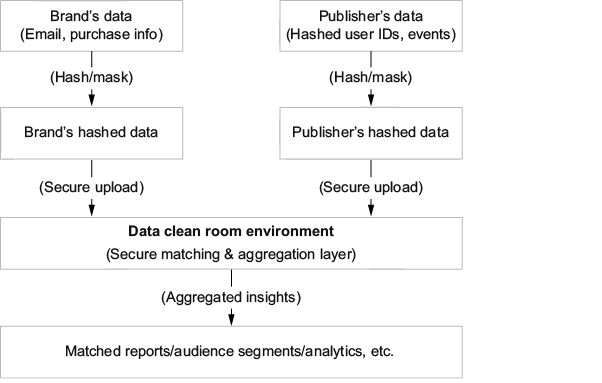
Follow the clean-room workflow from hashing or masking sensitive fields through secure matching to aggregated insights; it shows where identifier protection and output protection occur. section 8.2





