An ant is a simulated agent in ant colony optimization (ACO). It visits destinations, remembers its route, chooses where to go next, deposits pheromones, and tracks its total distance. Many ants explore possible solutions together, allowing useful paths to become more attractive over repeated iterations. section 6.1 section 6.3
A simulated ant typically has these responsibilities:
- Store visited destinations as memory and begin from a selected starting destination. section 6.3
- Choose the next destination randomly or through probability influenced by pheromone trails. section 6.3
- Calculate the total distance of its completed route using a distance matrix. section 6.3
- Contribute route information to pheromone updates while the colony compares its solution with others. section 6.4 section 6.9
Carnival attraction tour
Suppose attractions are represented by a distance matrix. An ant starts at a random attraction, records each destination it visits, and continues until every attraction has been visited. Its route length is calculated by adding the distances between consecutive attractions. After all ants complete tours, the colony updates pheromone trails, compares route lengths, and keeps the shortest route found so far. Repeating this process for several iterations returns the best path discovered. section 6.3 section 6.4
Figure 6.9 Properties of an ant
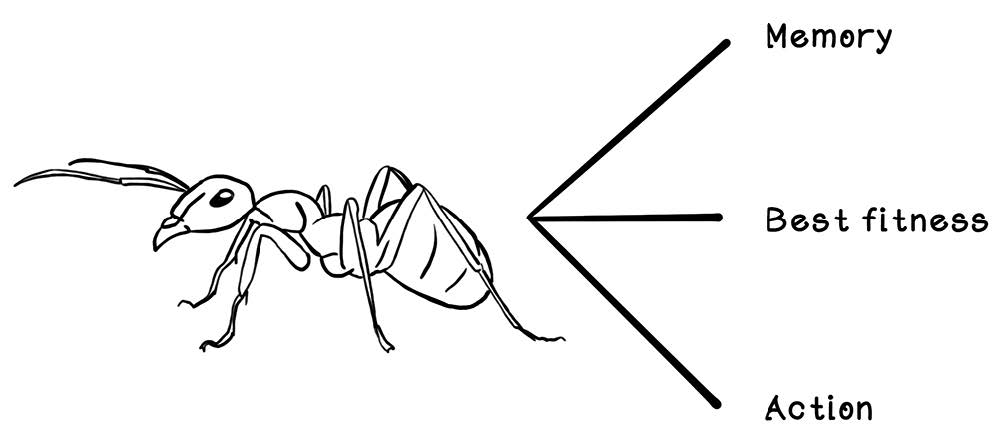
Use the property diagram to connect an ant's memory, best fitness, and movement action. section 6.3

