Population
A population is a defined group or complete set of people, units, observations, or candidate solutions considered together in a particular context.

Advanced Algorithms and Data Structures
A population is a collection of candidate individuals maintained by a genetic algorithm during an evolutionary iteration.
- How it is used
- Maintains multiple candidate solutions across genetic-algorithm generations instead of adjusting one solution at a time.
- How deep it goes
- Works through initialization and generation replacement in pseudocode, while leaving chromosome initialization and evolutionary operators problem-dependent.
- Examples
- Uses random bit-string populations for 0–1 knapsack and population-size comparisons for the traveling-salesperson problem.
- What you can do after
- Build it from scratch by initializing candidate individuals and replacing each generation through fitness-guided selection, crossover, and mutation.
Read how Advanced Algorithms and Data Structures explains population →

Optimization Algorithms: AI techniques for design, planning, and control problems
In evolutionary computation, a population is a set of candidate solutions maintained and evolved across iterations or generations.
- How it is used
- Uses populations to search for near-optimal solutions across generations of evolutionary computation.
- How deep it goes
- Explains initialization, evaluation, reproduction, survivor selection, termination, and population-size trade-offs, with Python implementations.
- Examples
- Uses a five-candidate ticket-pricing population to illustrate binary encoding, profit evaluation, and elitist survivor selection.
- What you can do after
- Builds a binary genetic algorithm from scratch in Python and applies a genetic algorithm using pymoo.
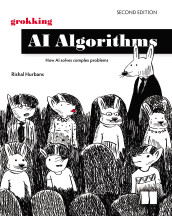
Grokking AI Algorithms, Second Edition
A population is the collection of candidate solutions maintained in an evolutionary algorithm at a particular generation.
- How it is used
- Uses populations to explore multiple areas of large optimization spaces and share traits across generations.
- How deep it goes
- Explains initialization, fitness, reproduction, replacement models, and diversity trade-offs, with a Python population generator.
- Examples
- Uses binary knapsack candidates, overweight penalties, and a 100-individual replacement comparison.
- What you can do after
- Builds a simple initial population from scratch and evaluates how fitness and replacement choices affect its evolution.
Read how Grokking AI Algorithms, Second Edition explains population →
Self-Improving Agents
A population is a collection of candidate solutions maintained together during a search process.
- How it is used
- Keeps multiple prompt candidates available so evolutionary search can explore beyond a single-candidate local optimum.
- How deep it goes
- Walks through parent selection, reflected mutation, crossover, scoring, and survivor retention, then traces how convergence limits the search.
- Examples
- Uses a revenue-agent prompt merge and generation views that mark parents, survivors, and discarded candidates.
- What you can do after
- Evaluate/understand it by tracking survivor pools, discarded branches, and convergence across search generations.
Classic Computer Science Problems in Swift: Essential techniques for practicing programmers
A population in a genetic algorithm is a collection of candidate solutions maintained as a group during evolution.
- How it is used
- Frames candidate solutions as a group that selection, reproduction, crossover, and mutation transform across generations.
- How deep it goes
- Defines population structure and gives implementation steps, while leaving population-size and probability choices configurable.
- Examples
- Uses antibiotic-resistant bacteria, random chromosome arrays, fitness caches, roulette selection, tournament selection, crossover, and mutation.
- What you can do after
- Operate/configure a GeneticAlgorithm population by choosing its size, selection method, crossover chance, mutation chance, and generation limit.
Causal AI
A population is the complete set of individuals, units, or observations about which an analysis seeks to generalize.
- How it is used
- Frames the set to which statistical or probabilistic conclusions are generalized, including heterogeneous groups and filtered subpopulations.
- How deep it goes
- Explains population modeling through distributions, conditional probability, stochastic processes, and IID sampling, but stops short of a full sampling-design treatment.
- Examples
- Uses future MNIST digits, website users, medicine recipients, players with high engagement, and randomly selected IID samples.
- What you can do after
- Evaluate/understand which population a model or probability statement describes and when a claim applies only to a subpopulation.
Grokking Statistics
A population is the complete set of filament units or production sources about which the analysis seeks to draw conclusions.
- How it is used
- Frames the target group or domain from which statistical conclusions are drawn, usually through a representative sample.
- How deep it goes
- Defines boundaries, distinguishes concrete from theoretical populations, and explains why census measurement often stops at sampling.
- Examples
- Uses collies, students, product owners, Pilates registrants, road events, dormitory sleep data, and filament production sources.
- What you can do after
- Evaluate whether observed data represents the intended population and recognize when conclusions require cautious sampling-based inference.

Inside AI
A population is a collection of candidate solutions maintained by a genetic algorithm.
- How it is used
- Uses populations to organize competing candidate solutions during genetic-algorithm optimization.
- How deep it goes
- Explains population lifecycle through evaluation, selection, crossover, mutation, generations, and stopping conditions.
- Examples
- Uses supply-chain routes, distribution plans, schedules, delivery time, and cost as candidate solutions and evaluation criteria.
- What you can do after
- Apply populations within genetic algorithms to compare, recombine, mutate, and iteratively improve candidate solutions.
Starting Data Analytics with Generative AI and Python
A population is the complete set of individuals, units, or observations about which a statistical analysis seeks to draw conclusions.
- How it is used
- Frames statistical inference around drawing conclusions about a population from sample data.
- How deep it goes
- Defines populations and samples, explains estimation with confidence intervals, and distinguishes complete-data calculation from sample-based inference.
- Examples
- Uses customer spending surveys, complete transaction data, and category-level sales-price and review-score intervals.
- What you can do after
- Evaluate whether a result describes a complete population or estimates one from a sample, including its uncertainty.
Read how Starting Data Analytics with Generative AI and Python explains population →
Evolutionary Deep Learning: Genetic algorithms and neural networks
A population is a collection of candidate solutions maintained together during an evolutionary optimization process.
- How it is used
- Maintains diverse candidate solutions through genetic-algorithm generations so evolutionary change can continue.
- How deep it goes
- Defines population structure, implements its tensor representation, and follows fitness, reproduction, mutation, replacement, and stopping criteria.
- Examples
- Uses binary NumPy tensors, a one-max problem, notebook listings, fitness histograms, and generation-level summary statistics.
- What you can do after
- Build it from scratch, evolve binary candidate populations, and inspect collective fitness across generations.
Read how Evolutionary Deep Learning: Genetic algorithms and neural networks explains population →
Also covered in
- Pandas Workout: 200 exercises to make you a stronger data analyst
- Machine Learning Algorithms in Depth
What to know first
- evolutionary computationEvolutionary computation is a family of search and optimization methods that iteratively improve candidate solutions through variation and selection inspired by biological evolution.
- normal distributionA normal distribution is a continuous probability distribution with a symmetric, bell-shaped density determined by its mean and variance.
- fitnessFitness is a numerical score indicating how well a candidate solution performs relative to an optimization objective.
- genetic algorithmA genetic algorithm is an evolutionary optimization method that improves a population of candidate solutions through fitness-based selection and variation, often including recombination and mutation.
Related concepts
- statistical samplehas part · A statistical sample is one or more observations selected or generated from a population or probability process for analysis.
- statehas part · State is information describing the condition or configuration of a system or computation at a particular time that may influence its behavior or subsequent transitions.
- particlehas part · A particle is an individual entity represented or managed as a unit within a physical or computational model.
- particle swarm optimizationused by · Particle swarm optimization is a population-based optimization method in which candidate solutions adjust their positions using individual and collective search information.
- genetic algorithmused by · A genetic algorithm is an evolutionary optimization method that improves a population of candidate solutions through fitness-based selection and variation, often including recombination and mutation.
- individualhas part · An individual is a single candidate solution represented as a member of an evolutionary algorithm's population and evaluated by its fitness.
Questions about population
What is population?
A population is a defined group or complete set of people, units, observations, or candidate solutions considered together in a particular context.
Which Manning books explain population?
Advanced Algorithms and Data Structures, Optimization Algorithms: AI techniques for design, planning, and control problems, Grokking AI Algorithms, Second Edition, Self-Improving Agents, Classic Computer Science Problems in Swift: Essential techniques for practicing programmers, Causal AI, Grokking Statistics, Inside AI and 2 more.
What should I know before learning population?
Manning books that teach population usually introduce evolutionary computation, normal distribution, fitness and genetic algorithm first.
What are the parts of population?
Population includes statistical sample, state, particle and individual.
These guides are generated from the text of Manning books by Manning's knowledge graph and link to the sections they draw on. The full books are available on liveBook and at manning.com.