A population is a collection of candidate solutions kept alive during search. A greedy search that keeps only one candidate can stall at a local optimum: every nearby change scores worse, even though a better solution lies beyond a dip. With candidates spread across the landscape, some may already be in that dip and able to climb toward the higher peak. Keeping more candidates helps exploration; it does not make any individual candidate smarter. section 4.1.3
Figure 4.3 A local optimum, and the population that escapes it. A single greedy climber (solid) reaches the near peak and stops, since the only way onward is down. A scattered population (hollow) keeps members out in the valley, and one of them crosses to the taller peak; the whole argument of this chapter is in that single crossing.
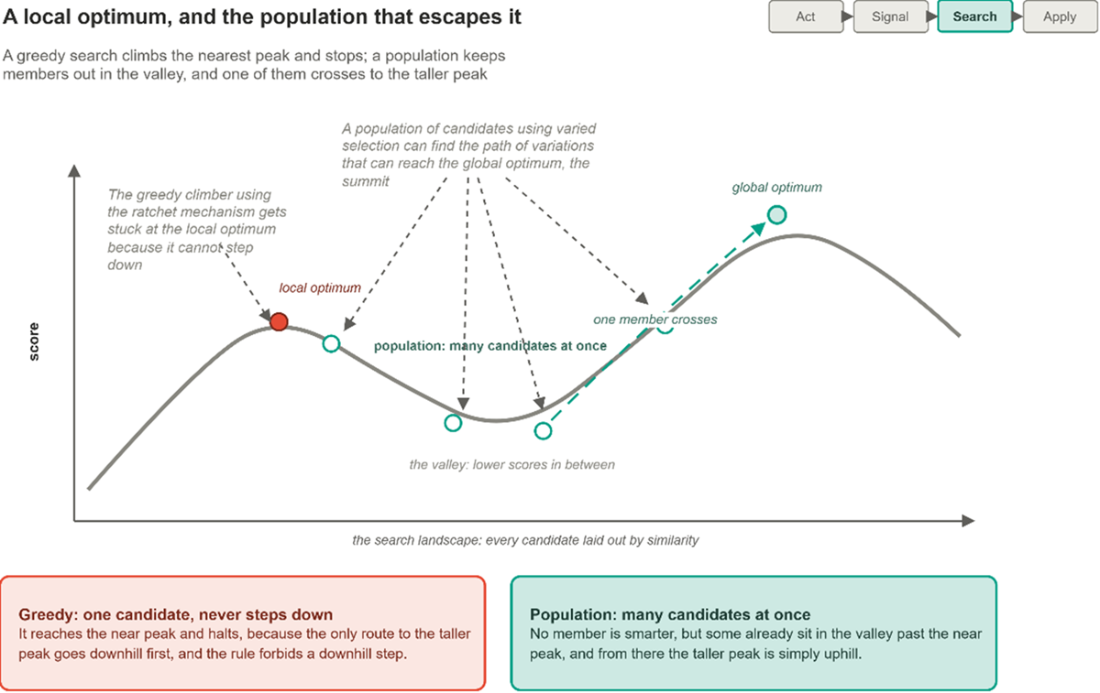
The scattered candidates show why a population can reach a peak that a single greedy climber cannot. section 4.1.3
In GEPA, the candidates are versions of an agent’s instructions, not different model weights. Each round selects parents, varies their prompts using reflection on execution traces and crossover, scores the children, and carries survivors forward. A Pareto front helps retain candidates with different strengths rather than reducing the pool to one top-ranked prompt. section 4.2.1 section 4.2.4
Combine two useful prompts
Suppose one prompt gets a revenue task’s refund rule right while another gets the quarter right. Crossover asks a model to merge their useful rules into a child prompt. The child is then measured and recorded with its score and parent lineage; whether it survives depends on selection, not on the promise of the merge. section 4.2.4
A population can still converge. As selection repeatedly keeps the same near-best candidates, later children rework those parents and the search may flatten before finding the last missing rule. Discarded candidates cannot be sampled again in GEPA’s shrinking survivor pool. By contrast, DGM retains an archive that can be sampled for older branches. The highest-scoring candidate is not automatically the one deployed: promotion remains a deliberate human gate. section 4.2.4 section 4.4.3
Figure 4.16 Convergence above memory: both runs in the Generations view. Each lane is one generation, and the chips in its gutter are the breeding pool at that moment: teal was picked as a parent, plain was available, struck through was already discarded. GEPA's pool freezes at two survivors while its discard pile grows, so every new child reworks the same two parents; DGM's pool only ever widens, and its champion ends a column the sampler reached back to after the rival branch burned two dead ends, which is the chapter's argument made literal.
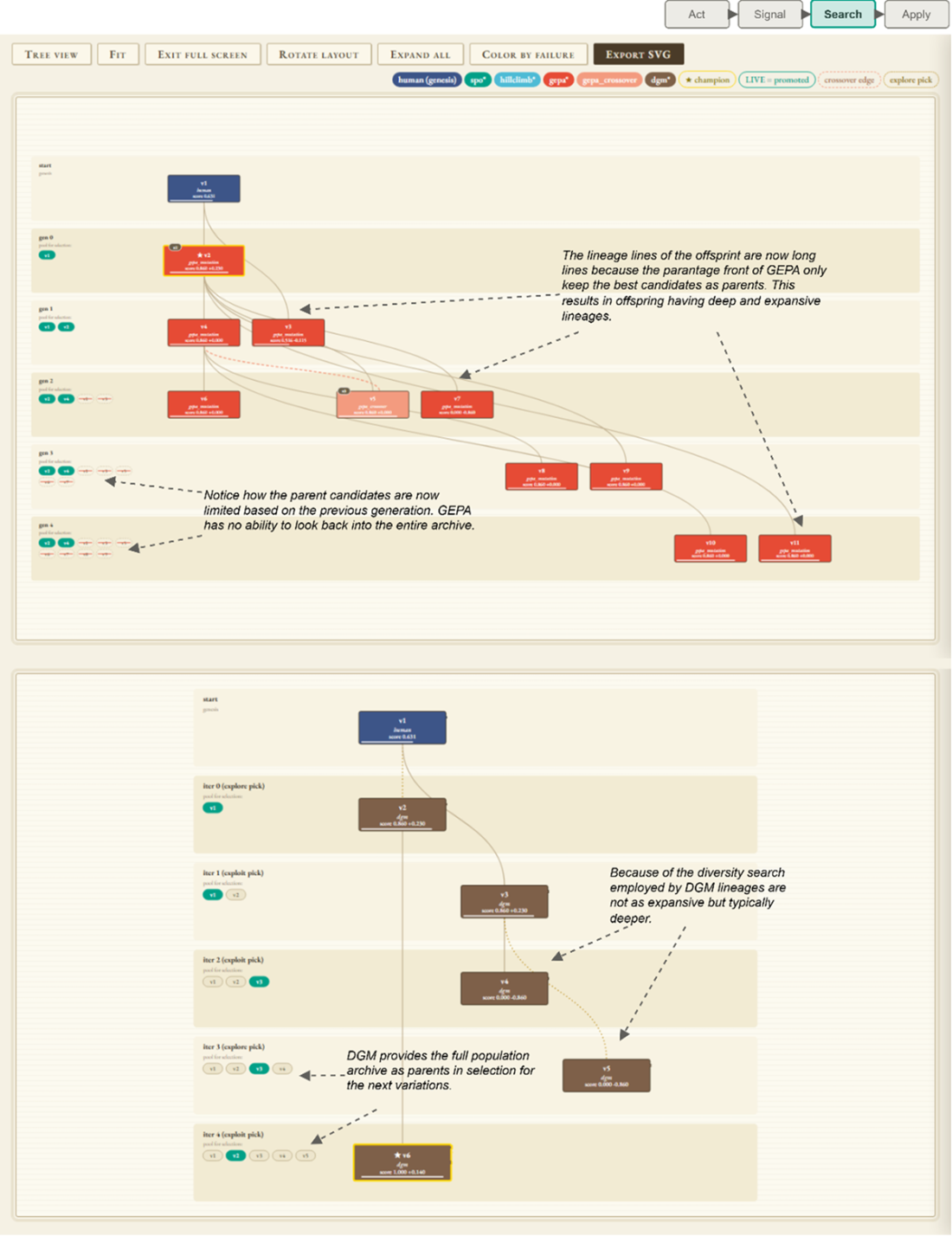
The generation lanes distinguish selected parents, available candidates, and discards, making convergence visible beside an archive that keeps widening. section 4.4.3









