A population is the complete group or domain you want to understand. It may be concrete, such as all adult collies in Scotland, or theoretical, such as every road event a self-driving car might encounter. Clear boundaries determine who or what belongs. section 2.5
Most analyses cannot measure an entire population. Instead, they use a sample and infer population attributes from it. Even data that looks complete may represent a wider set of possible people, products, events, or conditions. section 2.4 section 2.6
Define a population by asking:
- Which people, objects, or events are included? section 2.5
- Is the population concrete and accessible, or abstract and effectively unlimited? section 2.5
- Could the available data actually be only a sample from a broader population? section 2.6
Dormitory sleep study
A dormitory has 64 students, but only six receive sleep-tracking watches. The 64 students form the population; the six measured students form the sample. A small or poorly timed sample may miss important variation, so its average should not automatically describe everyone. section 2.6
Filament measurements
Filament measurements may target one spool, one factory, or production across several factories. The population definition determines whether sampling one spool is informative, and measurement conditions such as humidity can affect readings. section 10.22
Figure 2.1 Randomly selecting six people in a dormitory to participate in a sleep study
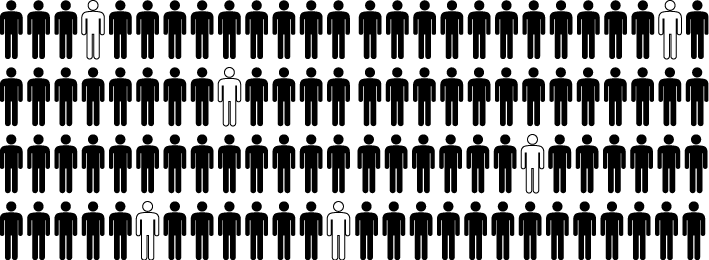
Use the dormitory diagram to see how a small random sample is selected from a larger population. section 2.6








