A population is the complete set of individuals, units, or observations about which an analysis seeks to generalize. In an MNIST deployment, it means every digit future document software will encounter, not merely the training dataset. section 2.3.1
Populations are heterogeneous: an intervention can help some subpopulations while harming or failing to affect others. Probability distributions model the overall population, while conditional probability narrows attention to groups such as users exposed to a feature or patients with particular characteristics. section 2.3.1 section 8.2.2
Population modeling connects generalization to practical analytical workflows:
- Use probability distributions or stochastic processes as models of populations and generate independent, identically distributed samples for inference. section 2.3.1 section 2.5
- Use conditional probability to express claims about a filtered group rather than silently applying them to the entire population. section 8.2.2
Targeting heterogeneous effects
A website feature may increase engagement on average but reduce engagement for a particular user segment. Modeling P(E | F=True, G="millennial") isolates the exposed millennial subpopulation and supports more targeted analysis. section 2.3.1
Figure 2.19 Creating a random sample by random selection from a population. Individuals are randomly selected from the population such that the sample distribution resembles the population distribution. The sample is identically and independently distributed (IID), meaning that sample members are selected the same way, and whether an individual is selected doesn’t depend on whether another individual was selected.
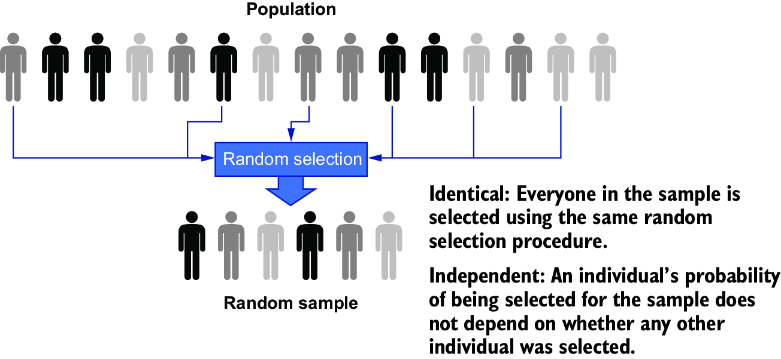
A random-selection diagram makes the relationship between a population and an IID sample explicit: the sample distribution is intended to resemble the population distribution. section 2.3.1








