A population is the complete set of individuals, units, or observations about which an analysis seeks conclusions. A sample is only part of that set. section 3.4
Suppose a company wants the average monthly spending of all customers on a product category. Surveying everyone may be impractical, so analysts select 100 customers and use their spending to estimate the population average. section 3.4.1
Use the population–sample distinction to interpret results carefully:
- Calculate a value directly when the dataset contains the complete population; do not treat it as an estimate. section 4.8
- Treat survey-based conclusions as uncertain because the sample may not perfectly represent the population. section 4.8 section 3.4.1
- Use confidence intervals to show plausible values for a population parameter rather than reporting only a sample result. section 3.4.1
Estimating customer spending
A sample of 100 customers has an average monthly spending of $200. A 95% confidence interval from $180 to $220 expresses uncertainty about the true average spending of all customers. section 3.4.1
Figure 4.6 Confidence intervals for (a) average sales price and (b) average review scores, for transactions in the “health and beauty” category of products
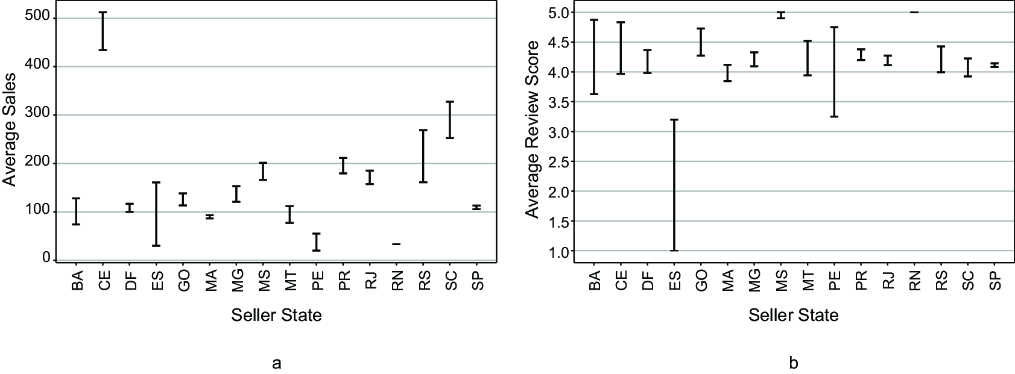
Compare confidence intervals for average sales prices and review scores to see how estimated population values vary across categories. section 4.8








