Anti-causal learning predicts a label from features that the label causes: Y → X, rather than the causal-learning direction X → Y. This distinction matters because the usefulness of unlabeled feature observations depends on the causal structure. section 5.3.2
For anti-causal prediction, learning can be viewed as estimating P(X|Y) and P(Y), then obtaining P(Y|X) through Bayes' rule. Unlabeled observations of X can improve the representation of P(X), helping infer P(Y|X). section 5.3.2
The practical implication is a causal test for semi-supervised learning:
- Expect unlabeled data to help when the label causes the features. section 5.3.2
- Treat unlabeled feature data as unlikely to improve the predictive mechanism when features cause the label. section 5.3.2
- Use causal knowledge to avoid spending data, compute, and engineering effort on mismatched algorithms. section 5.4
Handwritten digits
If Y is the handwritten digit and X is its image, the image is treated as an effect of the label. Unlabeled images can therefore contribute to learning a model for predicting the digit from the image. section 5.3.2
Sunscreen and sunburn
The prevalence of sunburn P(O) can help estimate sunscreen use P(C|O) when a sunburn is observed, illustrating how information about an effect can support reverse-direction prediction. section 5.3.2
Figure 5.16 In causal learning, the features cause the label. In anti-causal learning, the label causes the features.
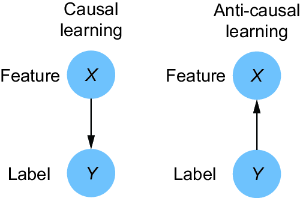
Compare the directed graphs X → Y and X ← Y to identify whether prediction follows causal or anti-causal direction. section 5.3.2
