Causal learning describes prediction when features X cause the target Y: the model learns in the direction X → Y. This contrasts with anti-causal learning, where Y causes X. section 5.3.2
The causal direction affects which data can improve a model. In causal learning, the task separates representations of P(X) and P(Y|X), so additional unlabeled X values improve P(X) but not the conditional prediction mechanism P(Y|X). section 5.3.2
Use the causal structure to guide modeling and resource allocation:
- Do not assume unlabeled feature data will improve semi-supervised learning when features cause labels; the expected gain is associated with the anti-causal case. section 5.3.2
- Distinguish causal learning from causal inference: causal structure can improve ordinary prediction even when the task is only to predict Y from X. section 5.3.2
- Account for more complex structures, including unobserved common causes of X and Y, rather than treating X → Y as universal. section 5.3.2
Image classification and sunscreen
For handwritten-digit images, the image X is treated as caused by the label Y, making the task anti-causal. By contrast, when features cause labels, unlabeled X does not update P(Y|X). The sunscreen-and-sunburn analogy illustrates why observing the effect can help infer its cause, but not the reverse learning arrangement. section 5.3.2
Figure 5.16 In causal learning, the features cause the label. In anti-causal learning, the label causes the features.
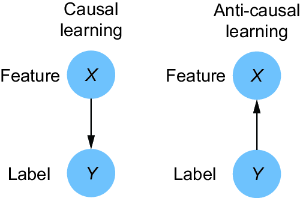
Compare the feature-to-label direction of causal learning with the label-to-feature direction of anti-causal learning. section 5.3.2
