Antigravity is an agent-first development platform that treats agents as workers and their outputs as artifacts. Its AI-powered editor is paired with an Agent Manager for spawning, orchestrating, and observing agents across the editor, terminal, and browser. The dashboard-like interface makes multi-agent work visible, but it should not be mistaken for a fully autonomous pipeline: as of early 2026, it remains closer to a command center than a complete pipeline orchestrator. section 5.6.4
Use Antigravity when the work benefits from decomposition and explicit oversight:
- Describe a multi-part engineering task and let agents divide it into implementation, testing, and documentation work. section 5.6.4
- Observe agent activity and inspect generated artifacts rather than accepting parallel output without review. section 5.6.4
- Use the CLI for narrow, composable operations such as summarizing logs, reviewing patches, or modifying files from shell pipelines. section 5.3.1
- Automate repeatable operational analysis, but retain a human decision point for triage and action. section 5.3.1
Morning operational triage
A scheduled shell script collects eight hours of payment-service logs, sends them to an agent for severity categorization and pattern analysis, and posts the resulting Markdown report to Slack. This turns repetitive analysis into infrastructure while leaving incident decisions to the team. section 5.3.1
Figure 5.4 Example of Antigravity Agent Manager interface with the focus on Agent Manager.
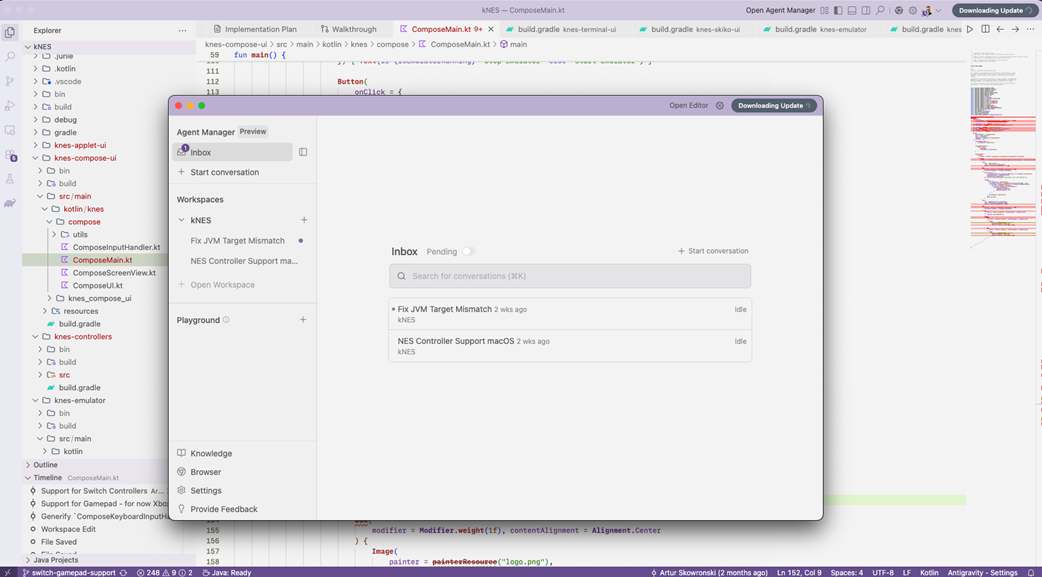
Inspect the Agent Manager interface to understand how Antigravity presents agents, orchestration, and deliverables as a project-management workspace. section 5.6.4
